ADHD and the brain
Martine Hoogman leads two projects to contribute to the understanding of the ADHD brain. The first is the international collaborative called ENIGMA-ADHD. The other project is the IMpACT-NL project, a local project dedicated to collecting multi-level data (cognition, genetics, microbiom, behavior and neuroimaging) in a sample of adults with ADHD and controls.
ENIGMA-ADHD
Many neuroimaging studies in ADHD have been published, each with its own contribution to science. However, brain imaging studies are expensive and therefore the sample size of studies is often small. Also, a wide variety of methods are used, which makes it difficult to compare studies. This all results in inconsistent findings and many uncertainties about the neurobiology of ADHD. To  address these issues we founded the ENIGMA-ADHD consortium. Here, more than 120 experts in the field are united to share their expertise and their data. This way we can reanalyze existing data in large meta-and mega-analyses to try to get as close as possible to finding true effects in the brain. Our first paper was published in The Lancet Psychiatry and received a lot of press.
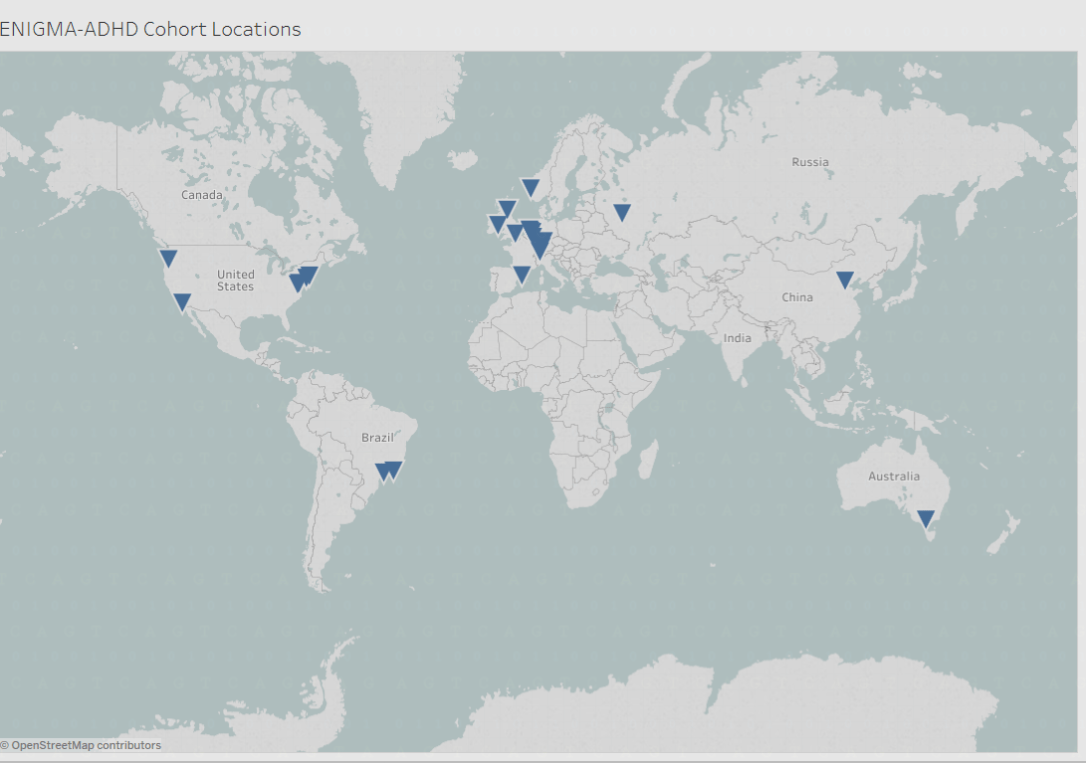
Displayed above are the collaborating sites; 41 in total, with brain data of over 4500 subjects (individuals with ADHD and healthy controls).
Current projects:
- Subcortical volume analysis of case-control differences (Martine Hoogman, Radboud University Medical Center, Nijmegen, The Netherlands). Completed: Manuscript published in the Lancet Psychiatry, Febr, 2017. [postprint]
- Anatomy of the cerebellum (Philip Shaw, National Institute of Mental Health, NIH, Bethesda, USA). Completed: Publised in Journal of Child Psychology and Psychiatry, Oct 2018. [postprint]
- Brain imaging of the cortex in ADHD (Martine Hoogman, Radboud University Medical Center, Nijmegen, The Netherlands). Completed: Manuscript published in the American Journal of Psychiatry, July 2019.
- ENIGMA ADHD, ASD, OCD cross-disorder project (Premika Boedhoe, Daan van Rooij, Martine Hoogman). Completed: Manuscript published in the American Journal of Psychiatry, 2020.
- Virtual Histology (Tomas Paus, Yash Patel, University of Toronto). Completed: Manuscript published in JAMA Psychiatry, Aug, 2020. [open access]
- Evidence for similar structural brain anomalies in youth and adult attention-deficit/hyperactivity disorder: a machine learning analysis (Yanli Zhang-James & Steve Faraone, SUNY Upstate University, USA). Completed: Manuscript published in Translational Psychiatry, 2021 [open access]
- Brain Laterality in ADHD (Merel Postema, Clyde Francks, MPI, Nijmegen). Completed: Manuscript published in the Journal of Child Psychology and Psychiatry, 2021. [open access]
- Characterizing heterogeneity of children with ADHD based on brain volume by using community detection (Ting Li, Radboud University Medical Center, Nijmegen, The Netherlands). Completed: Manuscript published in the Journal of Child Psychology and Psychiatry, 2021 [open access]
- White matter integrity in ADHD (Martine Hoogman, Kathy Lawrence) – Radboud University Medical Center). Ongoing – data inclusion is still open.
- Structural covariance in ADHD across the lifespan (Oliver Grimm, University of Frankfurt, Germany). Ongoing
- Using Deep Learning Neural Networks And Unsupervised Learning to Improve Model Discrimination of ADHD Cases And Controls (Yanli Zhang-James, SUNY Upstate University, USA). Ongoing
Together with the ENIGMA-ASD consortium, we wrote an article summarizing all our work for the special issue of Human Brain Mapping, celebrating 10 years of ENIGMA work. Hoogman, van Rooij, ….Buitelaar, Franke (2020). Consortium neuroscience of attention deficit/hyperactivity disorder and autism spectrum disorder: The ENIGMA adventure. Human Brain Mapping, may 2020. [open access]
please also see our booklet on ENIGMA-ADHD and other ENIGMA-working groups
IMpACT
IMpACT2-NL is an updated project and started as IMpACT1 in 2007. The aim of both IMpACT1&2 is to better understand adult ADHD. We do this by studying behavior, cognition, brain structure/functioning and genetics in both adults with ADHD and adults without ADHD. Our local IMpACT projects are embedded within the international IMpACT collaboration. Data collection is currently closed.
 Research group 'Strengths, positive aspects and resilience factors in neurodevelopmental conditions'