News

ADHDawareness, NWO Vidi

New publication: what do people with ADHD think about Neurodiversity

Okt 2026: Neurodiversiteit… Het is een hot topic waar steeds meer aandacht voor is. Het concept van neurodiversiteit verwijst naar de variatie in het menselijk denken en functioneren. In tegenstelling tot de klassiekere conceptualisaties door psychiaters in de jaren 60 worden aandoeningen zoals ADHD en autisme niet meer gezien als een “stoornis” die eigen is aan de persoon zelf. Binnen het neurodiversiteitsdenken wordt ADHD bijvoorbeeld gezien als een andere manier van denken en functioneren: niet beter of slechter, gewoon anders. Het woord “neurotypisch” verwijst doorgaans naar mensen die bij de middenmoot of meerderheid behoren terwijl de term “neurodivergent” verwijst naar onder andere mensen met bijvoorbeeld ADHD, autisme, of dyslexie.

Er wordt al veel gesproken en geschreven over neurodiversiteit, ook worden de eerste studies al gedaan naar dit onderwerp. Wat nog onbekend is: wat vinden mensen met ADHD zelf van dit concept? Samen met Impuls & Woortblind (de Nederlandse organisatie voor mensen met ADHD, dyslexie en dyscalculie) zetten we een vragenlijst op om dit te bevragen. Hierin werkten we samen met het Platform Wetenschap ADHD, een unieke samenwerking (co-creatie) die wetenschappers, behandelaren en ervaringsdeskundigen rondom ADHD bij elkaar brengt. Uiteindelijk konden we antwoorden verzamelen van 224 volwassenen met ADHD.

De meeste mensen (86%) hadden wel al eens gehoord van neurodiversiteit en 76% vond het neurodiversiteitsdenken een aantrekkelijke manier van denken. Mensen met ADHD definieerden neurodiversiteit op veel verschillende manieren, wat duidelijk maakt dat het concept geen eenduidige definitie heeft. Belangrijker is misschien nog dat volwassenen met ADHD in Nederland die de vragenlijst invulden zowel voor- als nadelen zagen aan het neurodiversiteitsdenken. Zo waren ze erg te spreken over het feit dat het concept van neurodiversiteit kan bijdragen aan meer acceptatie, erkenning en normalisatie van diversiteit. Ook het feit dat neurodiversiteit over iedereen gaat (iedereen heeft namelijk een unieke manier van zijn en denken), een neutralere term is dan medische diagnoses en minder dwingt om in hokjes te denken, vonden veel deelnemers positief.

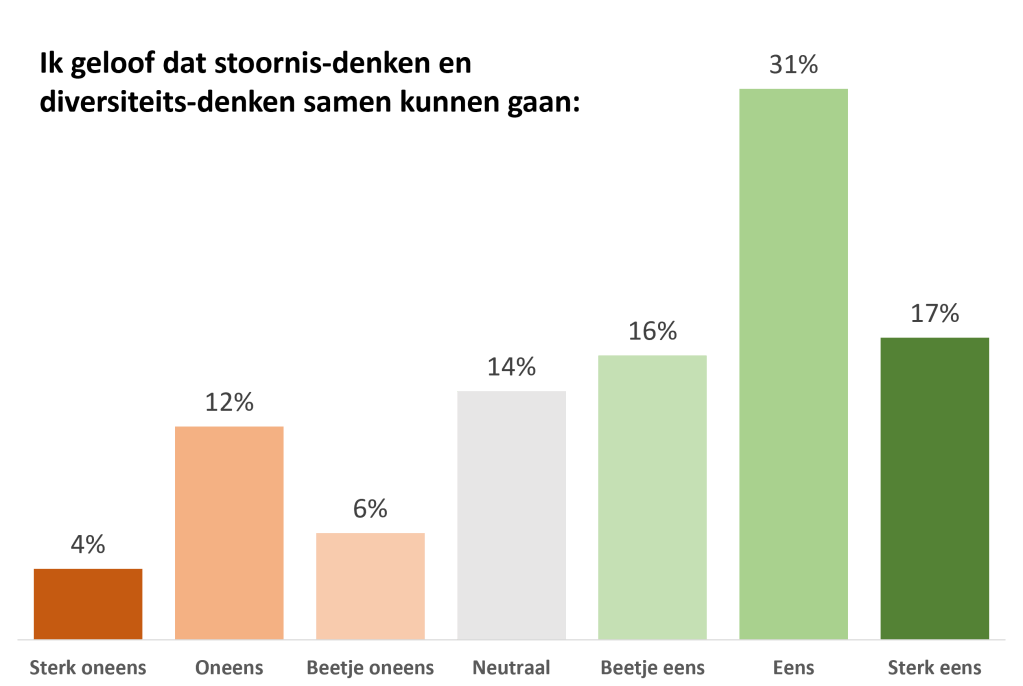
Tegelijkertijd gaven ze ook aan dat het concept neurodiversiteit wat vaag en breed kan zijn, want over wie hebben we het dan nog als het over iedereen gaat? En krijg je dan nog wel toegang tot zorg als het “gewoon maar” een andere manier van zijn en denken is? Toch is 64% van de deelnemers het eens dat het klassieke deficit-denken hand wel in hand kan gaan met het nieuwere neurodiversiteitsdenken (zie onderstaande figuur).
Onze resultaten tonen aan dat er nog veel discussie is over neurodiversiteit, met voor- en nadelen en met voor- en tegenstanders, ook binnen neurodivergente groepen zoals mensen met ADHD. We zullen ongetwijfeld nog veel veranderingen zien in hoe neurodiversiteit wordt gedefinieerd en hoe mensen zich daartoe verhouden. Het is alleszins belangrijk dat, wanneer we spreken over iets als neurodiversiteit en zeker neurodivergentie, we dat doen samen met de mensen over wie het gaat. Dit onderzoek is daarmee ook een belangrijk eerste samenwerkingsproduct uit het Platform Wetenschap ADHD.

Ben je benieuwd naar de volledige paper? Die kan je hier terugvinden:

De Roubaix, A., Schippers, L. M., Abels, R., Van Casteren, P., Franke, B., Greven, C. U., Hoekstra, P. J., Hurks, P. P. M., Meilink, A., Pereira, R. R., Scheres, A., Sobolewska, A. M., Van De Velde, H., Dekkers, T. J., & Hoogman, M. (2026). Perceptions of the Neurodiversity Concept: Threat or Opportunity for Adults With ADHD? Neurodiversity, 4. https://doi.org/10.1177/27546330261490602
Oct 2026: Neurodiversity is a hot topic that is receiving increasing attention. The concept of neurodiversity refers to the natural variation in human thinking and functioning. In contrast to more traditional conceptualizations developed by psychiatrists in the 1960s, conditions such as ADHD and autism are no longer viewed solely as disorders that reside within the individual. Within the neurodiversity paradigm, ADHD, for example, is seen as a different way of thinking and functioning: not better or worse, simply different. The term neurotypical generally refers to people whose cognitive and behavioral characteristics fall within the majority or average range, whereas neurodivergent refers to people with conditions such as ADHD, autism, or dyslexia.

Much has already been said and written about neurodiversity, and the first scientific studies on the topic have begun to emerge. What remains largely unknown, however, is how people with ADHD themselves view this concept. Together with Impuls & Woortblind (the Dutch organization for people with ADHD, dyslexia, and dyscalculia), we developed a survey to explore this question. The project was conducted in collaboration with the Platform Wetenschap ADHD, a unique co-creation initiative that brings together researchers, clinicians, and individuals with lived experience of ADHD. Ultimately, we collected responses from 224 adults with ADHD.

Most participants (86%) had heard of neurodiversity before, and 76% considered the neurodiversity perspective an appealing way of thinking. People with ADHD defined neurodiversity in many different ways, underscoring the absence of a single, universally accepted definition of the concept. Perhaps more importantly, Dutch adults with ADHD who completed the survey identified both advantages and disadvantages of the neurodiversity perspective.

Participants were particularly positive about the idea that neurodiversity may promote greater acceptance, recognition, and normalization of human differences. Many also appreciated that neurodiversity applies to everyone, since everyone has their own unique way of being and thinking. In addition, they viewed the concept as a more neutral term than medical diagnoses and as a framework that places less emphasis on categorizing people into rigid boxes.

At the same time, participants noted that the concept of neurodiversity can be somewhat vague and broad. If neurodiversity applies to everyone, they asked, who exactly are we referring to? They also questioned whether people would still have adequate access to care and support if ADHD were regarded as “just” a different way of being and thinking. Nevertheless, 64% of participants agreed that the traditional deficit-based perspective and the newer neurodiversity perspective can coexist and complement one another (see figure below).

Our results show that there is still much discussion surrounding neurodiversity, with both advantages and disadvantages, and with supporters as well as critics, including within neurodivergent groups such as people with ADHD. We will undoubtedly continue to see many changes in how neurodiversity is defined and how people relate to it. It is important, in any case, that when we talk about something like neurodiversity, and especially neurodivergence, we do so together with the people whom it concerns. This study therefore also represents an important first collaborative product of the Dutch ADHD Science Platform.

Are you curious about the full paper? You can find it here:

De Roubaix, A., Schippers, L. M., Abels, R., Van Casteren, P., Franke, B., Greven, C. U., Hoekstra, P. J., Hurks, P. P. M., Meilink, A., Pereira, R. R., Scheres, A., Sobolewska, A. M., Van De Velde, H., Dekkers, T. J., & Hoogman, M. (2026). Perceptions of the Neurodiversity Concept: Threat or Opportunity for Adults With ADHD? Neurodiversity, 4. https://doi.org/10.1177/27546330261490602
ADHD and creativity, NWO Vidi, Positive aspects of ADHD

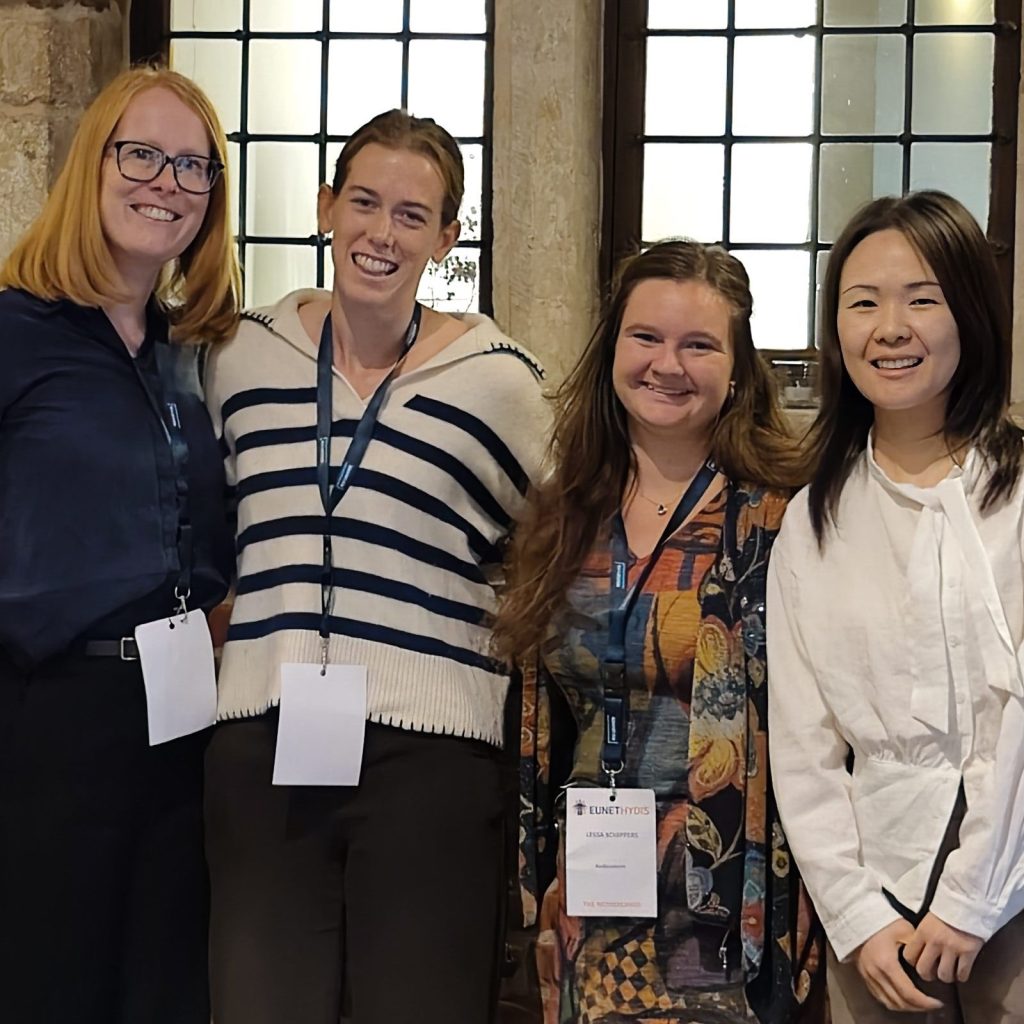
Team present at the 2026 EUNETHYDIS meeting in Leuven (and bringing home a poster award)

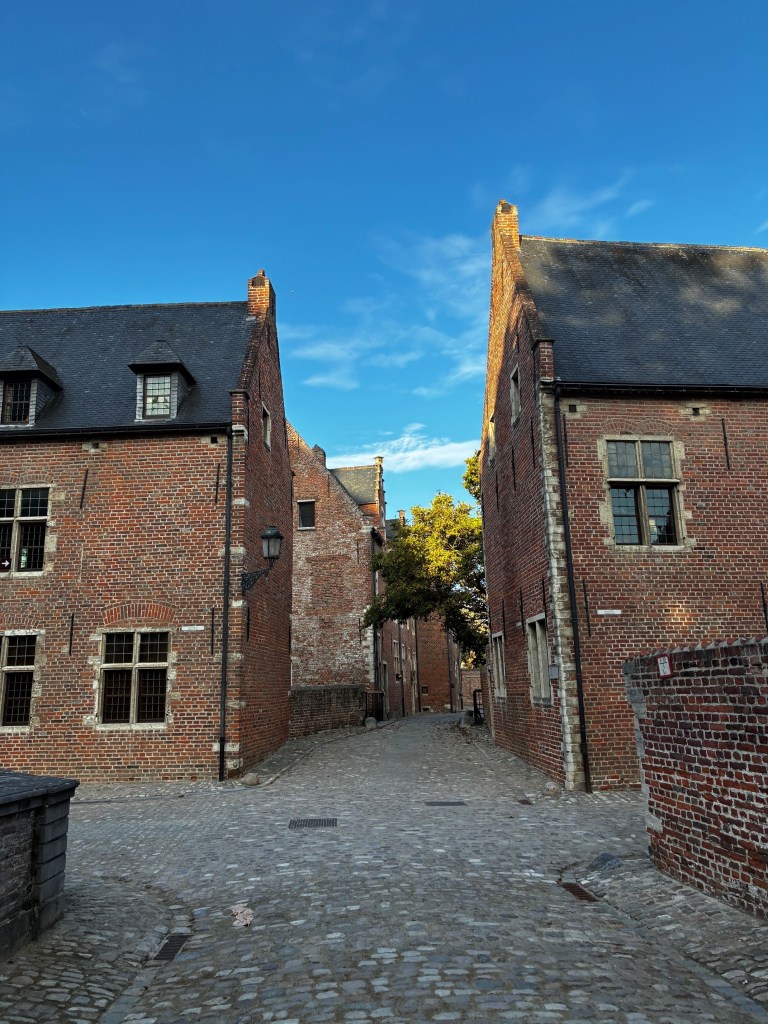
Okt 2026: Dit jaar trokken we met ons team naar Leuven in België voor de 37e editie van de jaarlijkse EUNETHYDIS-meeting. Dit congres brengt onderzoekers en clinici uit heel Europa samen rond ADHD. Naast het ontmoeten van collega’s en het leggen van nieuwe contacten, is het ook dé plek om op de hoogte te blijven van de nieuwste wetenschappelijke inzichten.

Amy de Roubaix, Jennifer de Smidt, Lessa Schippers & Han Fang + Martine Hoogman (not in the picture)

Ook dit jaar passeerden heel wat interessante studies de revue. Zo stelde men een project voor waarbij samen met mensen die op de wachtlijst staan voor een ADHD-diagnose, een psycho-educatieve app werd ontwikkeld. Daarnaast leerden we over de ontwikkeling van een virtuele assistent die getraind werd om betrouwbare informatie over ADHD te geven.

Een thema dat op verschillende momenten terugkwam, was taal. Hoe spreken we over ADHD? En welke woorden gebruiken we om mensen met ADHD te beschrijven? Daarbij werd benadrukt dat er geen universeel juiste taal bestaat waar iedereen zich in kan vinden. Wel groeit het bewustzijn dat bepaalde termen misschien beter vermeden worden. Zo werd bijvoorbeeld de term “healthy controls” ter discussie gesteld. Want wat bedoelen we precies als we een controlegroep “gezond” noemen? En wat zegt dat dan impliciet over mensen met ADHD?

Ook op het vlak van ouderbegeleiding werden interessante inzichten gedeeld. Zo bleek dat het niet alleen belangrijk is om ouders vaardigheden aan te leren, maar ook om hun vertrouwen in die vaardigheden te versterken. Rollenspellen tijdens therapie blijken daarbij een belangrijke rol te spelen.

Daarnaast leerden we meer over genetisch onderzoek naar ADHD. Daarbij werd erop gewezen dat veel grote genetische studies gebruikmaken van gegevens van deelnemers die werden gediagnosticeerd in de tijd van de DSM-IV. Omdat ADHD en autisme toen niet samen gediagnosticeerd konden worden, weerspiegelen deze onderzoeksgroepen mogelijk niet volledig de diversiteit van de ADHD-populatie die we vandaag kennen, waarin beide diagnoses regelmatig samen voorkomen.

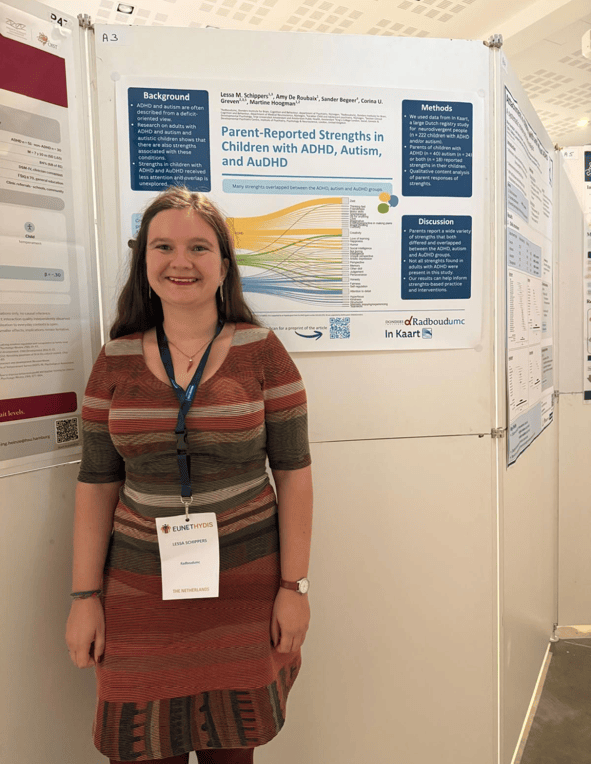
Ook het onderzoek uit onze onderzoeksgroep werd voorgesteld tijdens de postersessies. Vier onderzoekers presenteerden hun recente werk rond positieve aspecten van ADHD. Han Fang (PhD student) stelde haar meta-analyse over creativiteit bij ADHD voor. Lessa Schippers (PhD student) presenteerde haar onderzoek naar de positieve eigenschappen die ouders zien bij hun kind met ADHD en/of autisme. Jennifer de Smidt (PhD student) gaf een inkijk in de eerste resultaten van haar studie naar zowel de positieve als de uitdagende kanten van impulsiviteit bij ADHD, en naar de contextfactoren die bepalen hoe impulsiviteit tot uiting komt. Amy De Roubaix (Postdoc) presenteerde haar onderzoek naar de positieve eigenschappen die leerkrachten herkennen bij kinderen met ADHD, autisme, DCD, TOS en leerstoornissen.

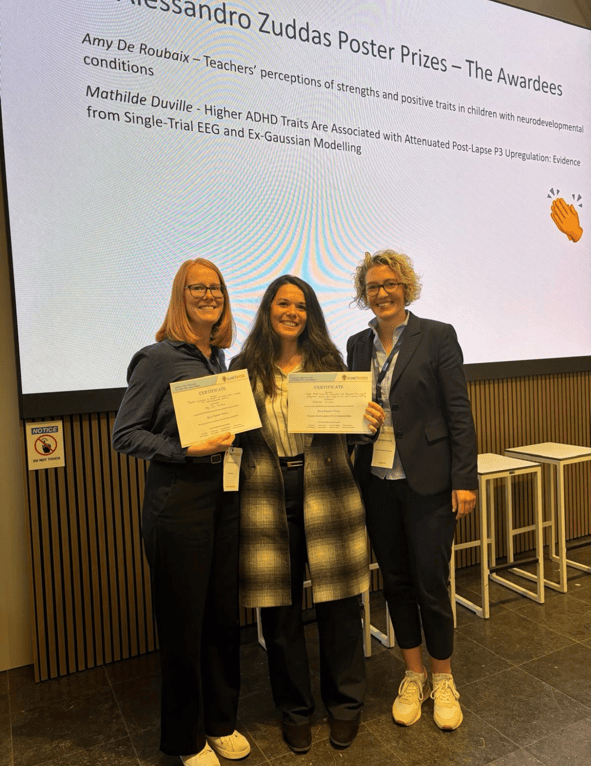
Als mooie afsluiter won dat laatste onderzoek bovendien één van de twee Alessandro Zuddas poster awards die tijdens het congres werden uitgereikt. Kortom, het was opnieuw een inspirerende editie vol nieuwe ideeën, boeiende gesprekken en verrassende inzichten. We kijken nu al uit naar de volgende EUNETHYDIS-meeting in Uppsala.

Oct 2026: This year, our team headed to Leuven in Belgium for the 37th edition of the annual EUNETHYDIS meeting. This conference brings together researchers and clinicians from across Europe to focus on ADHD. Beyond meeting colleagues and making new connections, it is also the ideal place to stay up to date with the latest scientific insights.
A number of interesting studies were presented again this year. For instance, a project was introduced in which a psycho-educational app was developed in collaboration with people on the waiting list for an ADHD diagnosis. We also learned about the development of a virtual assistant trained to provide reliable information about ADHD
One recurring theme was language. How do we talk about ADHD? And what words do we use to describe people with ADHD? It was emphasized that there is no universally "correct" language that everyone agrees on. However, there is growing awareness that certain terms might be best avoided. The term "healthy controls," for instance, was called into question. After all, what exactly do we mean when we label a control group "healthy"? And what does that implicitly imply about people with ADHD?

Interesting insights were also shared regarding parental guidance. It emerged that it is important not only to teach parents skills but also to strengthen their confidence in those skills. Role-playing during therapy proves to play a significant role in this regard.
In addition, we learned more about genetic research in ADHD. It was noted that many large-scale genetic studies utilize data from participants diagnosed during the DSM-IV era. Because ADHD and autism could not be diagnosed concurrently at that time, these study cohorts may not fully reflect the diversity of the ADHD population as we know it today, where the two diagnoses frequently co-occur.

Research from our group was also showcased during the poster sessions. Four researchers presented their recent work focusing on the positive aspects of ADHD. Han Fang (PhD student) presented her meta-analysis on creativity in ADHD. Lessa Schippers (PhD student) presented her research on the positive traits parents observe in their children with ADHD and/or autism. Jennifer de Smidt (PhD student) shared preliminary findings from her study examining both the positive and challenging aspects of impulsivity in ADHD, as well as the contextual factors that shape how impulsivity manifests. Amy De Roubaix (Postdoc) presented her research on the positive traits teachers recognize in children with ADHD, autism, DCD, DLD, and learning disabilities.

To top it all off, that final study won one of the two 'Alessandro Zuddas poster awards' presented during the conference. In short, it was once again an inspiring edition, full of new ideas, engaging conversations, and surprising insights. We are already looking forward to the next EUNETHYDIS meeting in Uppsala.
ADHDawareness, Other

An ADHD memory game at the Radboudumc Open Day

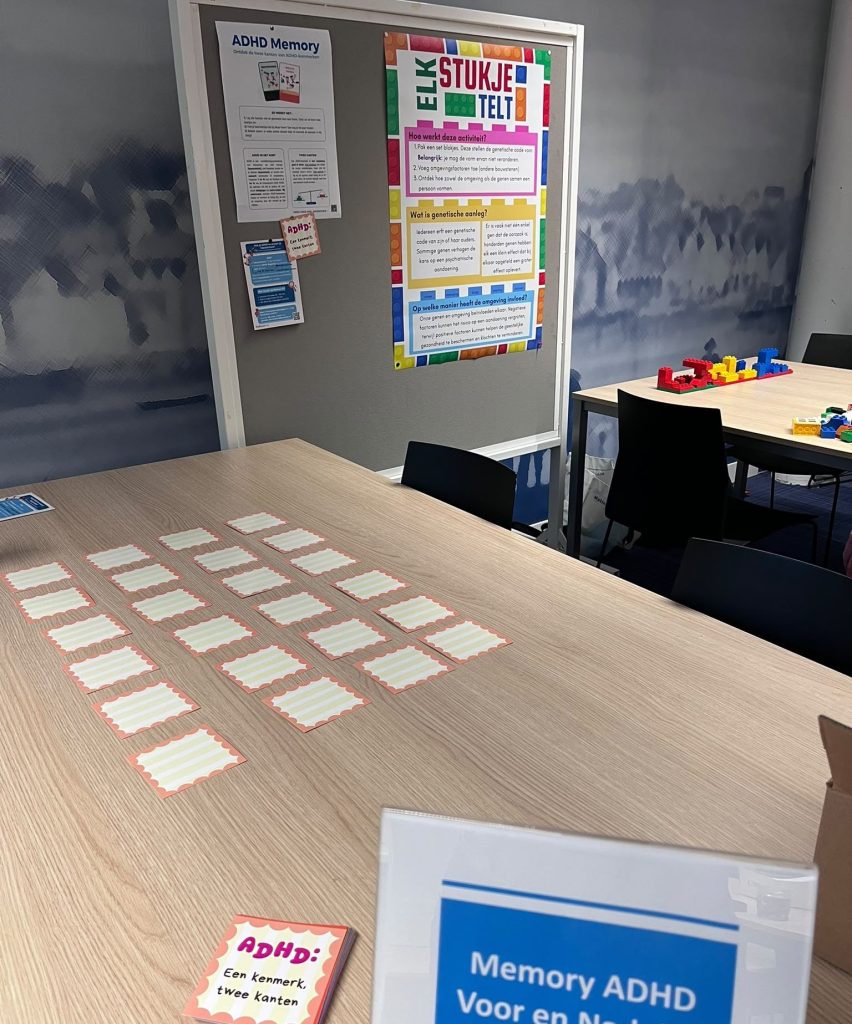
Okt 2026: Tijdens het Weekend van de Wetenschap hield het Radboudumc op zondag 4 oktober een open dag. Namens onze onderzoeksgroep stonden Jennifer de Smidt (PhD student) en Roos Rossen (master student) daar met een ADHD-memoryspel. Het spel laat zien dat ADHD-kenmerken niet simpelweg “goed” of “slecht” zijn, maar dat de context kan bepalen of een eigenschap een kracht of een uitdaging is.

Continue reading “An ADHD memory game at the Radboudumc Open Day” →
Uncategorized

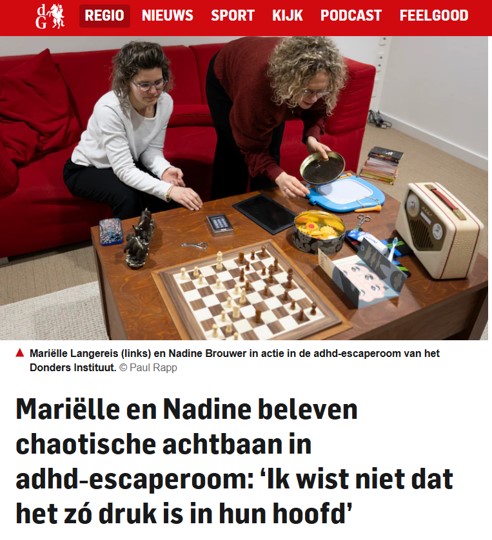
ADHD escape room bij de Vierdaagse Feesten

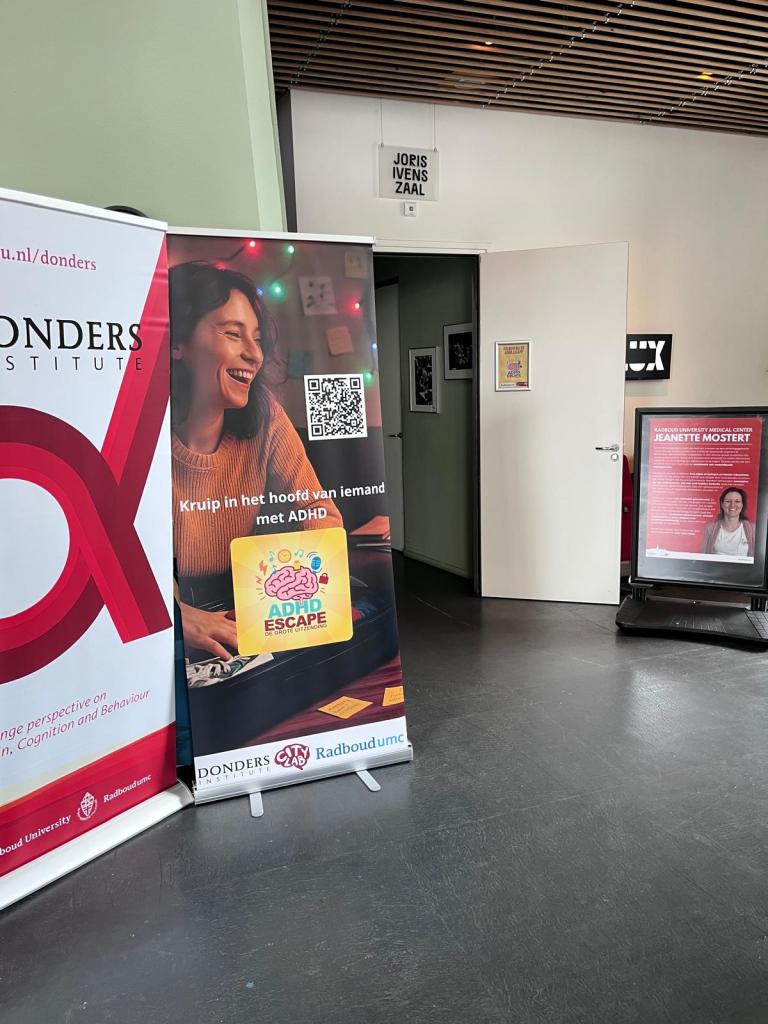
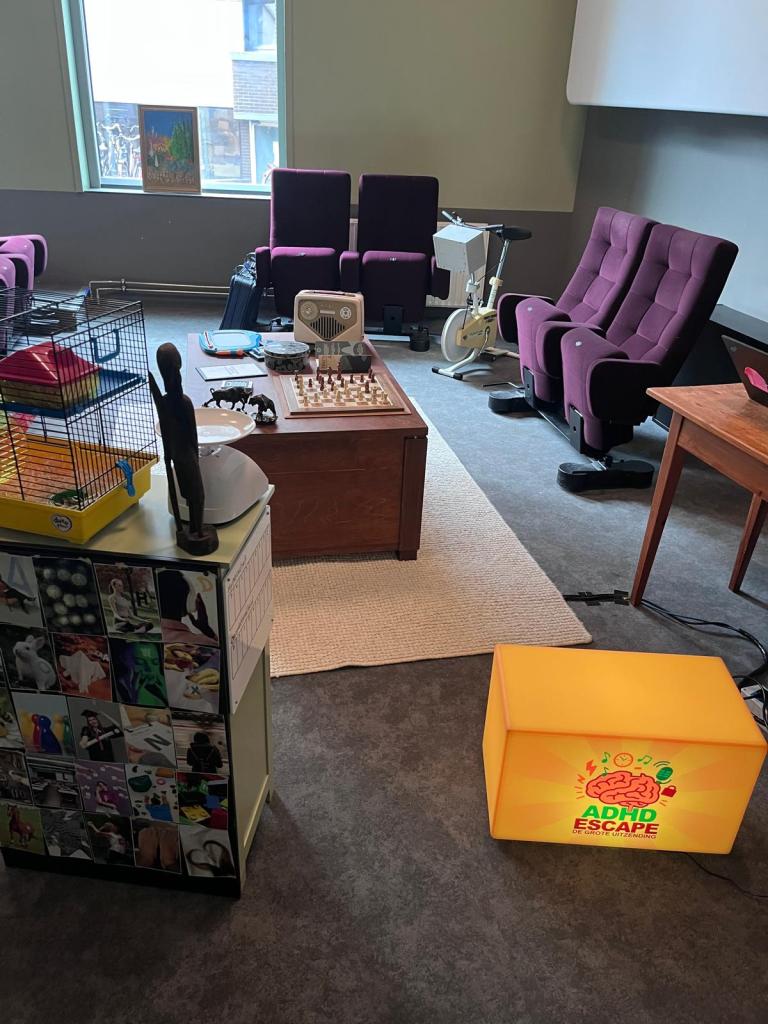
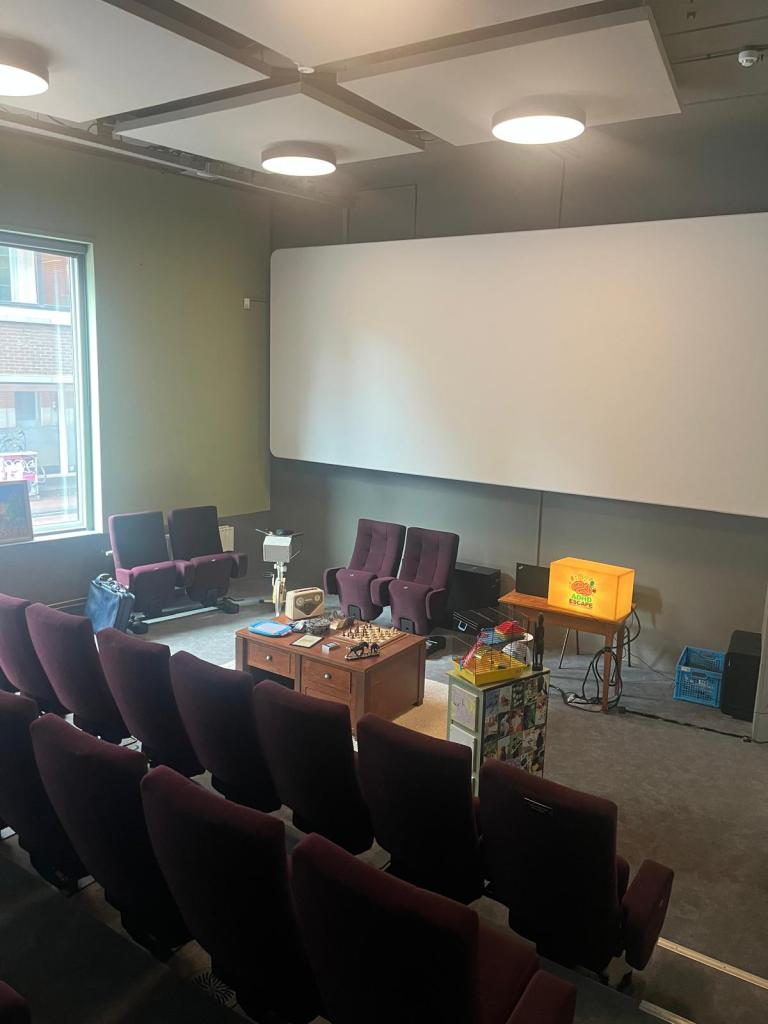
Juli 2026: Op 23 juli stond de ADHD Escape Room op wel een heel bijzondere plek: een bioscoopzaal van theater Lux. Hiermee waren we onderdeel van het Kids & Jongerenplein tijdens de Vierdaagsefeesten.

De Vierdaagse in Nijmegen is niet alleen een wandelfeest. Gedurende deze wandelweek zijn er overdag en ’s avonds allerlei activiteiten in de binnenstad van Nijmegen. Zo wordt het Mariënburg, achter bioscoop Lux, omgetoverd tot het Kids & Jongerenplein, met allerlei (wetenschaps-)activiteiten speciaal voor kinderen en jongeren. Een goede plek dus voor onze ADHD Escape Room!

Verschillende groepen bezoekers speelden die dag de ADHD Escape. Zo was er een groep vrienden onder wie 1 persoon ADHD had. Hij vond de opdrachten en ervaring heel herkenbaar, en een leuke manier om met zijn vrienden in gesprek te gaan over hoe het is om ADHD te hebben. Zowel de uitdagingen, als de dingen waar je met ADHD juist heel goed in bent. Zijn vrienden vonden het een mooie manier om hem wat beter te begrijpen. En daarnaast hadden ze ook veel plezier gehad.

Meer informatie over de ADHD Escape room vind je hier: https://dondersdiscovers.nl/adhd-escape-de-grote-uitzending/

Into Nijmegen bezocht onze ADHD Escape en schreef er een mooi artikel over: https://www.intonijmegen.com/blijf-op-de-hoogte/verhaal/een-kijkje-in-het-adhd-brein-in-de-educatieve-escape-room-adhd-escape

Uncategorized

New publication by PhD-student Han: ADHD and creativity in childhood

September 2026: A new study by Han Fang, Teemu Toivainen, Corina Greven, and Martine Hoogman, published online in the Journal of Experimental Child Psychology, explores the relationship between childhood ADHD traits, writing-based creativity, and later well-being.

Creativity is often discussed as a potential strength associated with ADHD, and some studies in adults support a positive association. However, evidence in children remains limited, particularly for creativity assessed through completed creative products.

Using data from 1,170 children in the Twins Early Development Study, the researchers examined ADHD traits at age 8, creativity in written stories at age 9, and well-being at age 16.

The study found a small negative association between inattentiveness and writing-based creativity. Hyperactivity/impulsivity was not significantly associated with writing-based creativity. The researchers also found no evidence that this form of creativity buffered the association between childhood ADHD traits and lower well-being in adolescence.

These findings underline the importance of being specific when discussing creativity in ADHD. Performance on a written-story task does not capture the full range of creative abilities, and the results cannot be generalized to all forms of creativity or all developmental stages. A small association at the group level also does not determine an individual child’s creative strengths or potential.

Our group’s other (unpublished) qualitative studies in parents of children with ADHD and in teachers identify creativity associated with ADHD, therefore the current findings leave open the possibility of positive associations in other creative domains or at other developmental stages. They also raise questions about whether differences in creativity assessments might help explain the contrasting findings across studies of children and adults.

For our group, developing a balanced understanding of ADHD includes investigating where proposed strengths are supported by evidence and where the picture is more complex. This study highlights the need to examine different forms of creativity across development.

Building on these questions, Han is working on a systematic review and meta-analysis examining ADHD and different domains of creativity in children and adults. This work is not yet published, and we look forward to sharing the findings when they are available.

Read the open-access article:
“The relationship between product-based creativity and ADHD traits in children and the associations with later well-being”
https://doi.org/10.1016/j.jecp.2026.106670

Uncategorized

Shortlisted for the Radboudumc Open Science Award 2026

After winning last year’s Radboudumc Envision award, we were shortlisted for the Radboudumc Open Science Award this year.

The close collaboration between the Sensitivity Lab (PI Corina Greven) and my lab (Positive aspects of neurodevelopmental conditions) was shortlisted for the Radboudumc Open Science Award 2026. This year the focus was on citizen science. With the involvement in Hooggevoelig Heel Gewoon and Hoogsensitief.nl, the realization of the ongefilterd- campaign, the founding of the ADHD science Platform and the Radboudumc neurodiversity network ‘SUNNI’ and we have collectively created many new citizen science projects within the domain of neurodiversity.

We did not win but we all get a lot of energy by practicing open science, we believe that “Science advances most effectively when knowledge is shared openly and created together with the public.”

more information here: Reflection, recognition, and next steps at Research Strategy Day 2026 – Three Radboudumc research awards announced at Strategy Day – Radboudumc

and here https://www.radboudumc.nl/getmedia/7c8059f1-5a61-4025-80db-ffdb3f0cc359/Award-ceremony-17-June-2026.pdf

Other

Jennifer and ‘Pint of Science’ Nijmegen

Mei 2026: Hebben vissen gevoelens? Hoe beïnvloeden wereldwijde voedingsrichtlijnen onze eetcultuur? Wat zegt onze ademhaling over hooikoorts? En hoe combineren werkende mantelzorgers zorg en werk in een vergrijzende samenleving? Tijdens Pint of Science stapten wetenschappers wereldwijd even uit hun lab of achter hun computer vandaan om in de kroeg te vertellen over hun onderzoek. Het internationale festival maakt wetenschap toegankelijk met interactieve presentaties, laagdrempelige gesprekken en een drankje binnen handbereik.

In Nijmegen stond dit jaar het thema Science through the lens of past, present & future centraal. Onderzoekers spraken over mentale gezondheid, malaria, kunstrestauratie en meer. Dit jaar mocht PhD-student Jennifer de Smidt van onze groep zelf meewerken aan de organisatie als onderdeel van de Pint of Science Nijmegen-commissie.

Continue reading “Jennifer and ‘Pint of Science’ Nijmegen” →
Uncategorized

ADHDplaza in Didactief

Mei 2026: Voor ons ADHDplaza project ontwikkelden wij een les over ADHD voor middelbare scholen. We delen die les op onze website en hopen dat docenten hier gebruik van maken, en hem bijvoorbeeld gebruiken tijdens een mentor uur. Onze ervaring is dat met name jongeren met ADHD die in de les zitten, het fijn vinden om op deze manier een ingang te vinden om eens stil te staan bij hoe het voor hen is. We hebben de les samen met een jongerenpanel en met onderwijs professionals ontwikkeld. Het onderwijsvakblad Didactief schrijft hier over.