ADHD and creativity, ADHDawareness, NWO Vidi, Positive aspects of ADHD

Interview Martine Hoogman in de Libelle

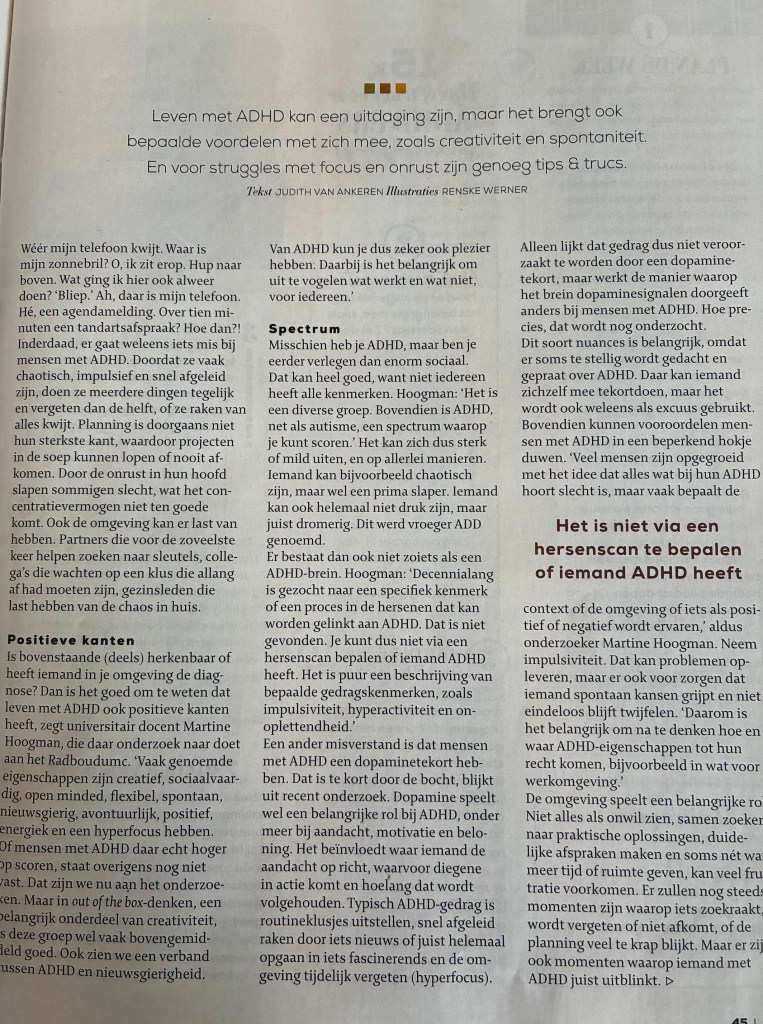
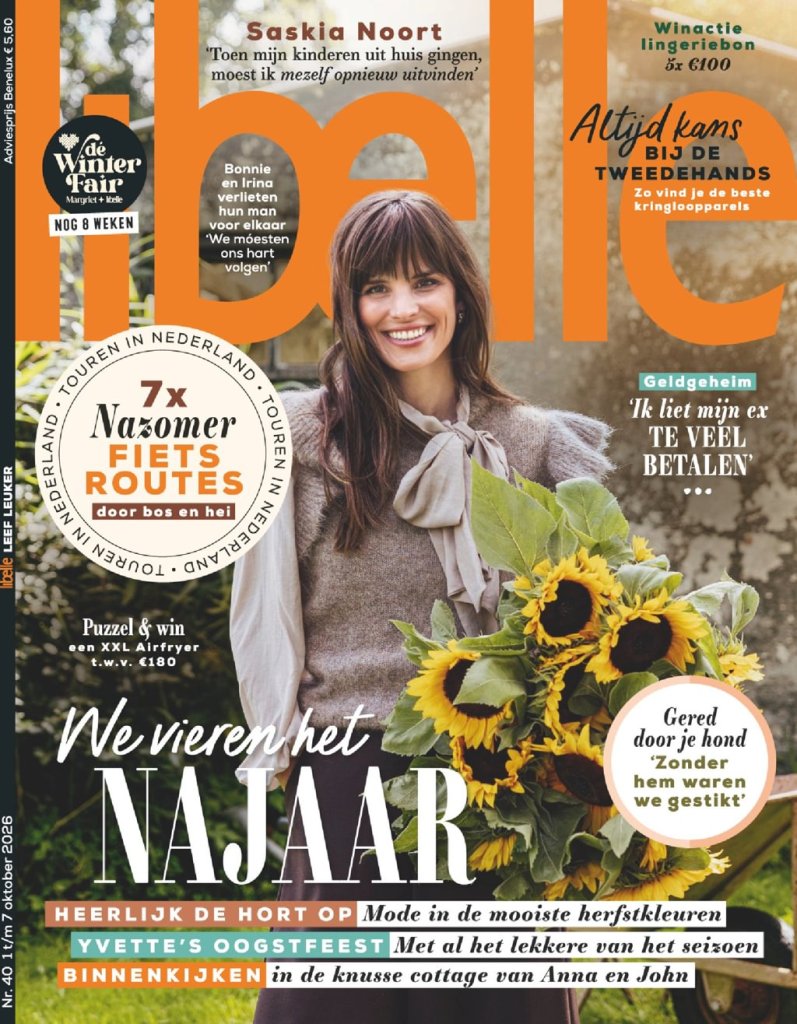
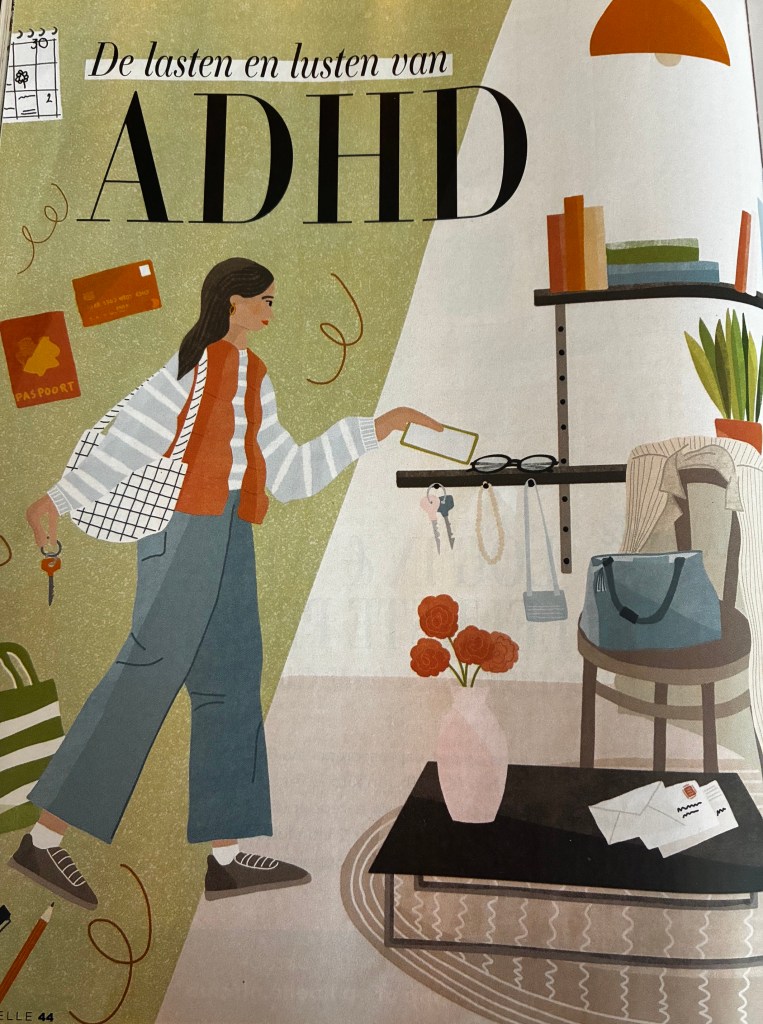
Okt 2026: Een tijdje geleden werd ik gevraagd om mee te werken aan een artikel over ADHD in de Libelle. In eerste instantie werd er gevraagd om uitleg te geven over de hersenen van mensen met ADHD en over dopamine. Dat zijn onderwerpen waar anderen meer van weten en heb de journalist doorverwezen naar andere experts, maar ik heb haar ook laten weten dat mijn expertise ligt op het gebied van de positieve aspecten van ADHD.
Wanneer er over ADHD wordt gesproken, gaat het meestal over de uitdagingen (logisch, want die uitdagingen zijn de reden waarom mensen op zoek gaan naar hulp en eventueel een diagnose). Problemen met aandacht, impulsiviteit, hyperactiviteit of moeite met plannen krijgen begrijpelijk veel aandacht. Die uitdagingen kunnen een grote impact hebben op het dagelijks leven. Tegelijkertijd vertelt dat soms niet het hele verhaal.

In gesprekken met mensen met ADHD en met de Vereniging voor mensen met ADHD, dyslexie, dyscalculie (Impuls & Woortblind) hoor ik ook regelmatig over andere kanten van ADHD. Bijvoorbeeld over creativiteit, enthousiasme, nieuwsgierigheid, en het vermogen om buiten de gebaande paden te denken. Veel mensen beschrijven dat zij een enorme energie kunnen ervaren wanneer zij bezig zijn met iets waar hun interesse ligt. Ook noemen zij vaak spontaniteit, humor en een sterke gevoeligheid voor wat er in hun omgeving gebeurt.

Dat betekent natuurlijk niet dat ADHD altijd een voordeel is of dat de moeilijkheden genegeerd moeten worden. Een positief perspectief mag nooit leiden tot het bagatelliseren van de uitdagingen die veel mensen ervaren. Wel geloof ik dat het belangrijk is om een compleet beeld te schetsen, anders zullen we nooit helemaal begrijpen wat ADHD is. In mijn onderzoeksgroep werken we met zijn allen heel hard om positieve aspecten van ADHD een andere neurobiologische ontwikkelingsstoornissen te onderzoeken.

Juist daarom vond ik het waardevol om aan dit interview mee te werken. Het biedt een kans om het gesprek over ADHD te verbreden. Niet alleen door te kijken naar wat moeilijk gaat, maar ook naar talenten, kwaliteiten en sterke kanten die met ADHD kunnen samenhangen. Ik waardeer het dat Libelle aandacht besteedt aan dit onderwerp en hoop dat het artikel bijdraagt aan meer begrip, herkenning en een evenwichtiger beeld van ADHD.

Martine

October 2026: Some time ago, I was asked to contribute to an article about ADHD in Libelle (one of the largest and most widely read women’s magazines in the Netherlands). Initially, the journalist wanted information about the brains of people with ADHD and the role of dopamine. Those are topics on which other experts have greater expertise, so I referred her to colleagues who specialize in those areas. However, I also mentioned that my own expertise lies in the positive aspects of ADHD.

When ADHD is discussed, the focus is usually on the challenges people experience. This makes sense, as these challenges are often the reason why individuals seek help and, potentially, a diagnosis. Difficulties with attention, impulsivity, hyperactivity, and planning understandably receive a great deal of attention. These challenges can have a significant impact on daily life. At the same time, they sometimes do not tell the whole story.

In conversations with people with ADHD and with the Dutch association for people with ADHD, dyslexia, and dyscalculia (Impuls & Woortblind), I also frequently hear about other sides of ADHD. People often talk about creativity, enthusiasm, curiosity, and the ability to think outside the box. Many describe experiencing a tremendous amount of energy when they are engaged in something that genuinely interests them. They also often mention spontaneity, humor, and a strong sensitivity to what is happening around them.

Of course, this does not mean that ADHD is always an advantage or that the difficulties associated with it should be ignored. A positive perspective should never lead to minimizing the challenges that many people experience. However, I believe it is important to present a complete picture, because otherwise we will never fully understand what ADHD is. In our research group, we are working hard to investigate the positive aspects of ADHD and other neurodevelopmental conditions.

That is precisely why I found it valuable to participate in this interview. It provides an opportunity to broaden the conversation about ADHD. Not only by looking at the difficulties people face, but also by exploring the talents, qualities, and strengths that may be associated with ADHD. I appreciate that Libelle is giving attention to this topic, and I hope the article contributes to greater understanding, recognition, and a more balanced view of ADHD.

Martine
ADHD and creativity, NWO Vidi, Positive aspects of ADHD

Team present at the 2026 EUNETHYDIS meeting in Leuven (and brings home a poster award)

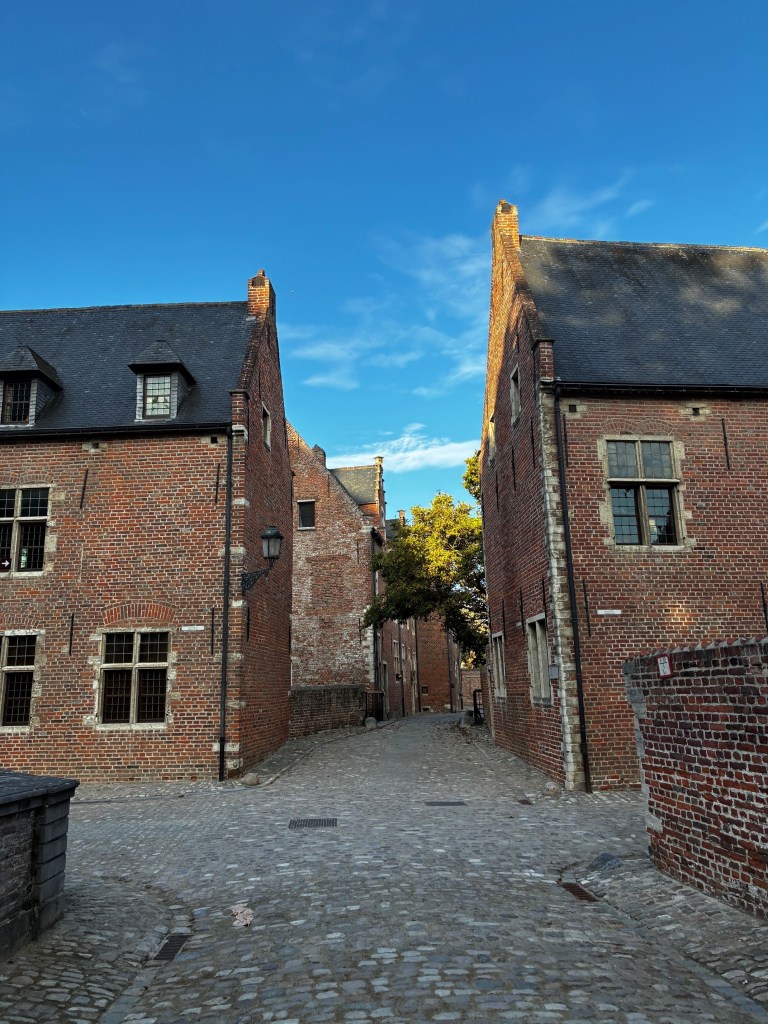
Okt 2026: Dit jaar trokken we met ons team naar Leuven in België voor de 37e editie van de jaarlijkse EUNETHYDIS-meeting. Dit congres brengt onderzoekers en clinici uit heel Europa samen rond ADHD. Naast het ontmoeten van collega’s en het leggen van nieuwe contacten, is het ook dé plek om op de hoogte te blijven van de nieuwste wetenschappelijke inzichten.

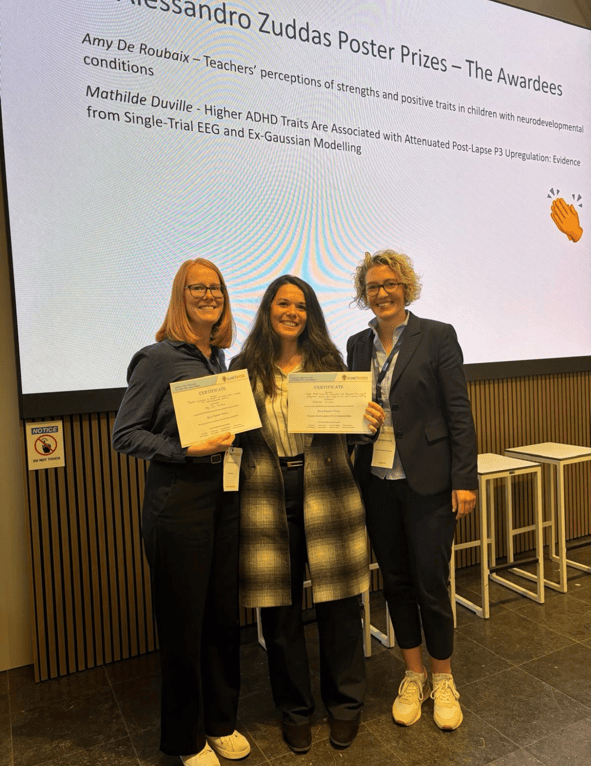
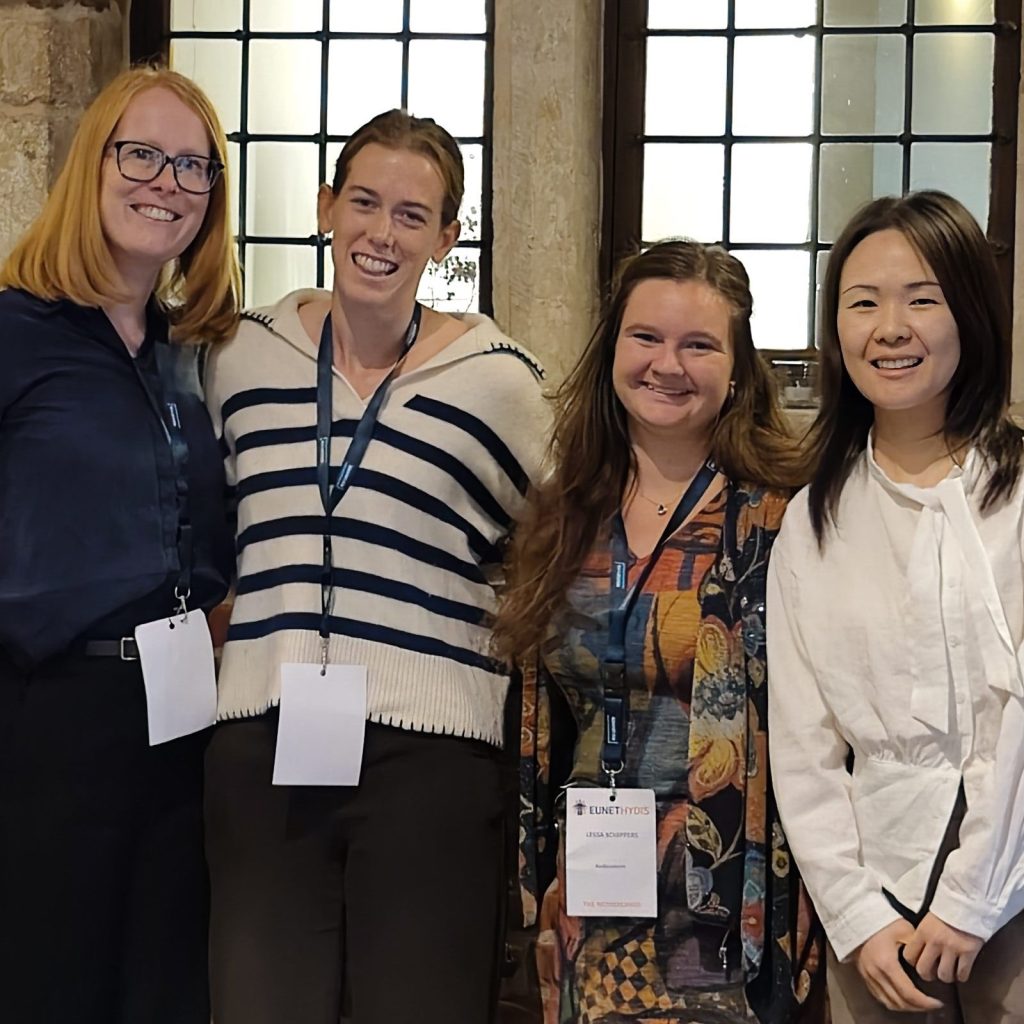
Amy de Roubaix, Jennifer de Smidt, Lessa Schippers & Han Fang + Martine Hoogman (not in the picture)

Ook dit jaar passeerden heel wat interessante studies de revue. Zo stelde men een project voor waarbij samen met mensen die op de wachtlijst staan voor een ADHD-diagnose, een psycho-educatieve app werd ontwikkeld. Daarnaast leerden we over de ontwikkeling van een virtuele assistent die getraind werd om betrouwbare informatie over ADHD te geven.

Een thema dat op verschillende momenten terugkwam, was taal. Hoe spreken we over ADHD? En welke woorden gebruiken we om mensen met ADHD te beschrijven? Daarbij werd benadrukt dat er geen universeel juiste taal bestaat waar iedereen zich in kan vinden. Wel groeit het bewustzijn dat bepaalde termen misschien beter vermeden worden. Zo werd bijvoorbeeld de term “healthy controls” ter discussie gesteld. Want wat bedoelen we precies als we een controlegroep “gezond” noemen? En wat zegt dat dan impliciet over mensen met ADHD?

Ook op het vlak van ouderbegeleiding werden interessante inzichten gedeeld. Zo bleek dat het niet alleen belangrijk is om ouders vaardigheden aan te leren, maar ook om hun vertrouwen in die vaardigheden te versterken. Rollenspellen tijdens therapie blijken daarbij een belangrijke rol te spelen.

Daarnaast leerden we meer over genetisch onderzoek naar ADHD. Daarbij werd erop gewezen dat veel grote genetische studies gebruikmaken van gegevens van deelnemers die werden gediagnosticeerd in de tijd van de DSM-IV. Omdat ADHD en autisme toen niet samen gediagnosticeerd konden worden, weerspiegelen deze onderzoeksgroepen mogelijk niet volledig de diversiteit van de ADHD-populatie die we vandaag kennen, waarin beide diagnoses regelmatig samen voorkomen.

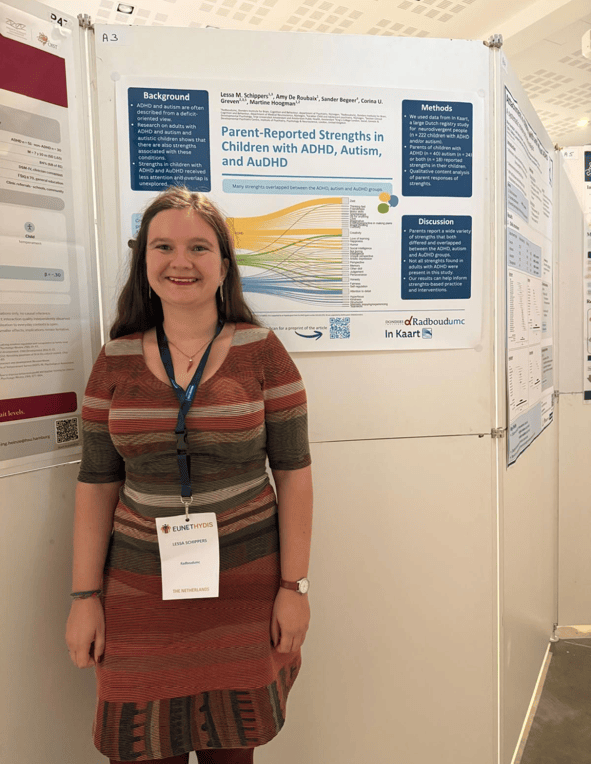
Ook het onderzoek uit onze onderzoeksgroep werd voorgesteld tijdens de postersessies. Vier onderzoekers presenteerden hun recente werk rond positieve aspecten van ADHD. Han Fang (PhD student) stelde haar meta-analyse over creativiteit bij ADHD voor. Lessa Schippers (PhD student) presenteerde haar onderzoek naar de positieve eigenschappen die ouders zien bij hun kind met ADHD en/of autisme. Jennifer de Smidt (PhD student) gaf een inkijk in de eerste resultaten van haar studie naar zowel de positieve als de uitdagende kanten van impulsiviteit bij ADHD, en naar de contextfactoren die bepalen hoe impulsiviteit tot uiting komt. Amy De Roubaix (Postdoc) presenteerde haar onderzoek naar de positieve eigenschappen die leerkrachten herkennen bij kinderen met ADHD, autisme, DCD, TOS en leerstoornissen.

Als mooie afsluiter won dat laatste onderzoek bovendien één van de twee Alessandro Zuddas poster awards die tijdens het congres werden uitgereikt. Kortom, het was opnieuw een inspirerende editie vol nieuwe ideeën, boeiende gesprekken en verrassende inzichten. We kijken nu al uit naar de volgende EUNETHYDIS-meeting in Uppsala.

Oct 2026: This year, our team headed to Leuven in Belgium for the 37th edition of the annual EUNETHYDIS meeting. This conference brings together researchers and clinicians from across Europe to focus on ADHD. Beyond meeting colleagues and making new connections, it is also the ideal place to stay up to date with the latest scientific insights.

A number of interesting studies were presented again this year. For instance, a project was introduced in which a psycho-educational app was developed in collaboration with people on the waiting list for an ADHD diagnosis. We also learned about the development of a virtual assistant trained to provide reliable information about ADHD.

One recurring theme was language. How do we talk about ADHD? And what words do we use to describe people with ADHD? It was emphasized that there is no universally “correct” language that everyone agrees on. However, there is growing awareness that certain terms might be best avoided. The term “healthy controls,” for instance, was called into question. After all, what exactly do we mean when we label a control group “healthy”? And what does that implicitly imply about people with ADHD?

Interesting insights were also shared regarding parental guidance. It emerged that it is important not only to teach parents skills but also to strengthen their confidence in those skills. Role-playing during therapy proves to play a significant role in this regard.

In addition, we learned more about genetic research in ADHD. It was noted that many large-scale genetic studies utilize data from participants diagnosed during the DSM-IV era. Because ADHD and autism could not be diagnosed concurrently at that time, these study cohorts may not fully reflect the diversity of the ADHD population as we know it today, where the two diagnoses frequently co-occur.

Research from our group was also showcased during the poster sessions. Four researchers presented their recent work focusing on the positive aspects of ADHD. Han Fang (PhD student) presented her meta-analysis on creativity in ADHD. Lessa Schippers (PhD student) presented her research on the positive traits parents observe in their children with ADHD and/or autism. Jennifer de Smidt (PhD student) shared preliminary findings from her study examining both the positive and challenging aspects of impulsivity in ADHD, as well as the contextual factors that shape how impulsivity manifests. Amy De Roubaix (Postdoc) presented her research on the positive traits teachers recognize in children with ADHD, autism, DCD, DLD, and learning disabilities.

To top it all off, that final study won one of the two ‘Alessandro Zuddas poster awards’ presented during the conference. In short, it was once again an inspiring edition, full of new ideas, engaging conversations, and surprising insights. We are already looking forward to the next EUNETHYDIS meeting in Uppsala.

ADHD and creativity, NWO Vidi, Positive aspects of ADHD

New publication by PhD-student Han: ADHD and creativity in childhood

September 2026: A new study by Han Fang, Teemu Toivainen, Corina Greven, and Martine Hoogman, published online in the Journal of Experimental Child Psychology, explores the relationship between childhood ADHD traits, writing-based creativity, and later well-being.

Creativity is often discussed as a potential strength associated with ADHD, and some studies in adults support a positive association. However, evidence in children remains limited, particularly for creativity assessed through completed creative products.

Using data from 1,170 children in the Twins Early Development Study, the researchers examined ADHD traits at age 8, creativity in written stories at age 9, and well-being at age 16.

The study found a small negative association between inattentiveness and writing-based creativity. Hyperactivity/impulsivity was not significantly associated with writing-based creativity. The researchers also found no evidence that this form of creativity buffered the association between childhood ADHD traits and lower well-being in adolescence.

These findings underline the importance of being specific when discussing creativity in ADHD. Performance on a written-story task does not capture the full range of creative abilities, and the results cannot be generalized to all forms of creativity or all developmental stages. A small association at the group level also does not determine an individual child’s creative strengths or potential.

Our group’s other (unpublished) qualitative studies in parents of children with ADHD and in teachers identify creativity associated with ADHD, therefore the current findings leave open the possibility of positive associations in other creative domains or at other developmental stages. They also raise questions about whether differences in creativity assessments might help explain the contrasting findings across studies of children and adults.

For our group, developing a balanced understanding of ADHD includes investigating where proposed strengths are supported by evidence and where the picture is more complex. This study highlights the need to examine different forms of creativity across development.

Building on these questions, Han is working on a systematic review and meta-analysis examining ADHD and different domains of creativity in children and adults. This work is not yet published, and we look forward to sharing the findings when they are available.

Read the open-access article:
H. Fang, T. Toivainen, C. U. Greven, M Hoogman, The relationship between product-based creativity and ADHD traits in children and the associations with later well-being,
Journal of Experimental Child Psychology, Volume 274, 2027, 106670, ISSN 0022-0965, https://doi.org/10.1016/j.jecp.2026.106670.

ADHD and creativity, ADHDawareness, NWO Vidi, Positive aspects of ADHD

Lecture about ADHD at the Donders Open day

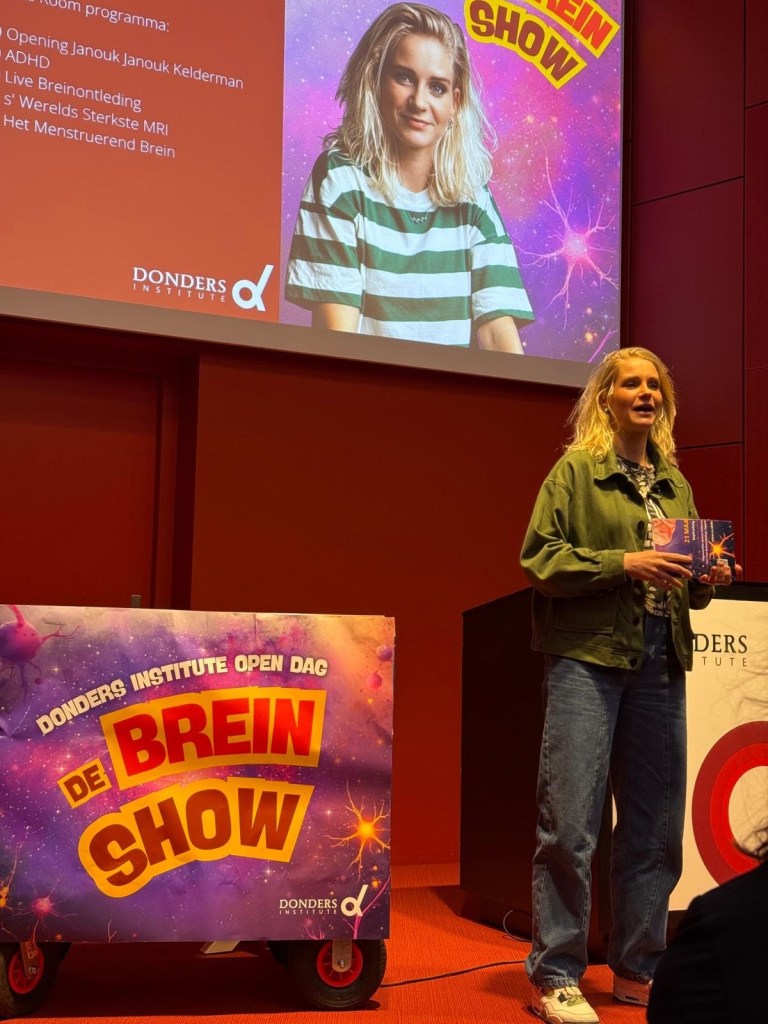
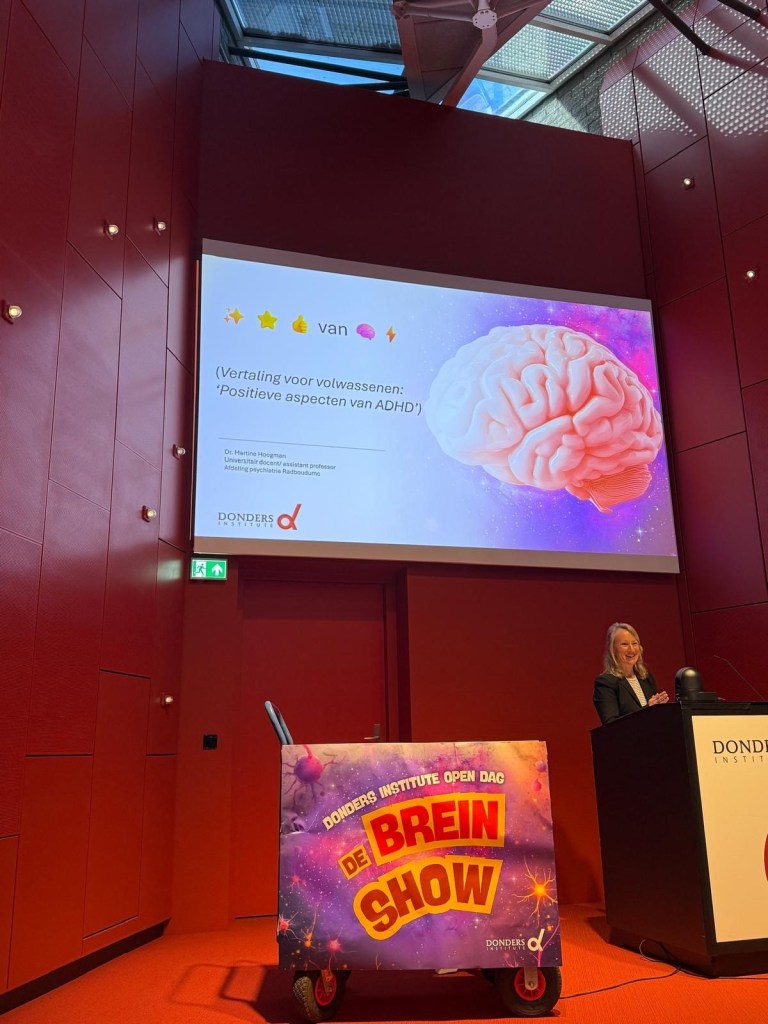
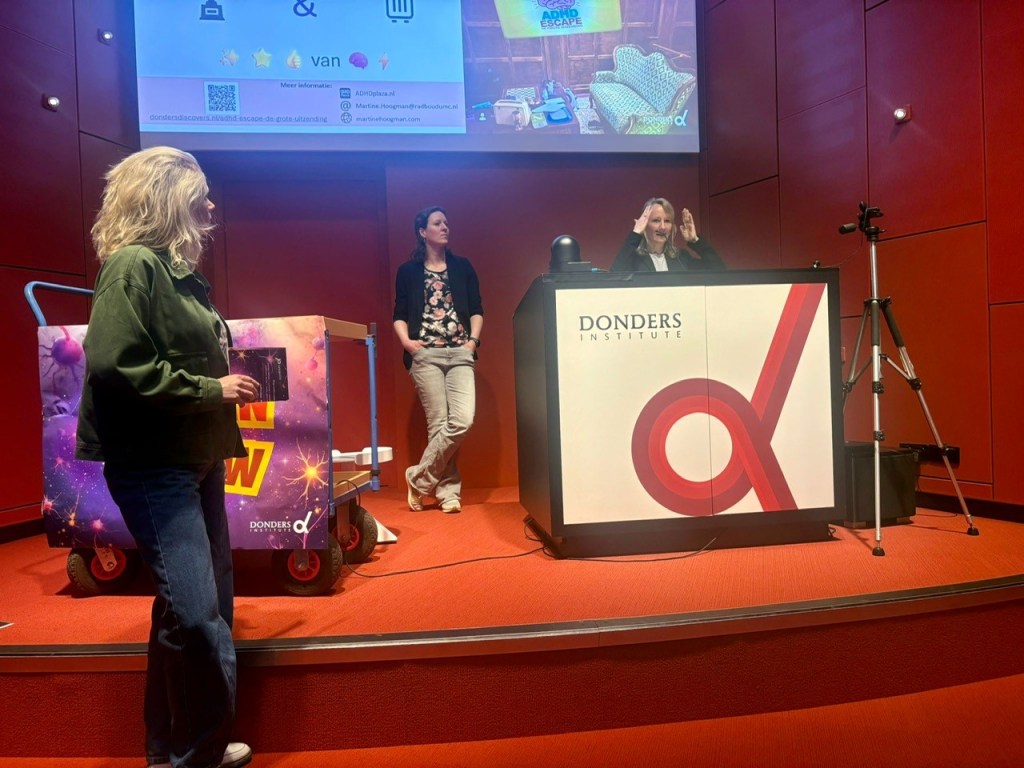
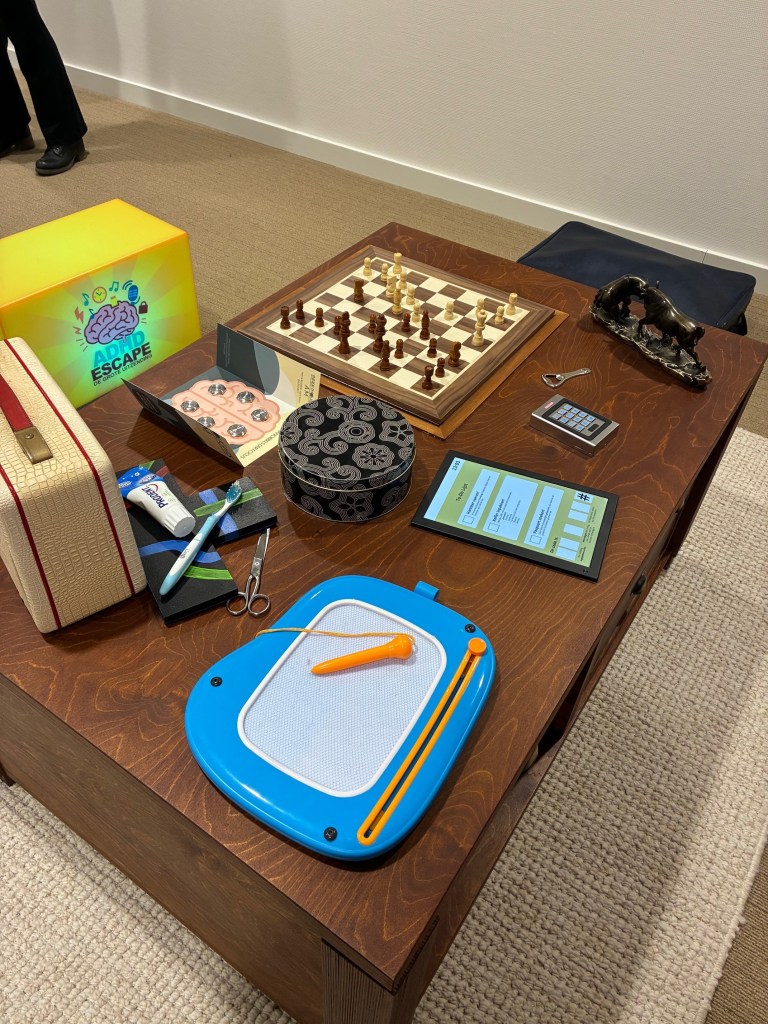
March 2026: on the 21st of March the Donders Institute opened their doors for the public. On this day many researchers displayed their work; there were lab tours, escape rooms (also ours), short talks, experiments and experiences. Martine gave a lecture about positive aspects of ADHD in the Red Room. The room was full and many questions were answered!

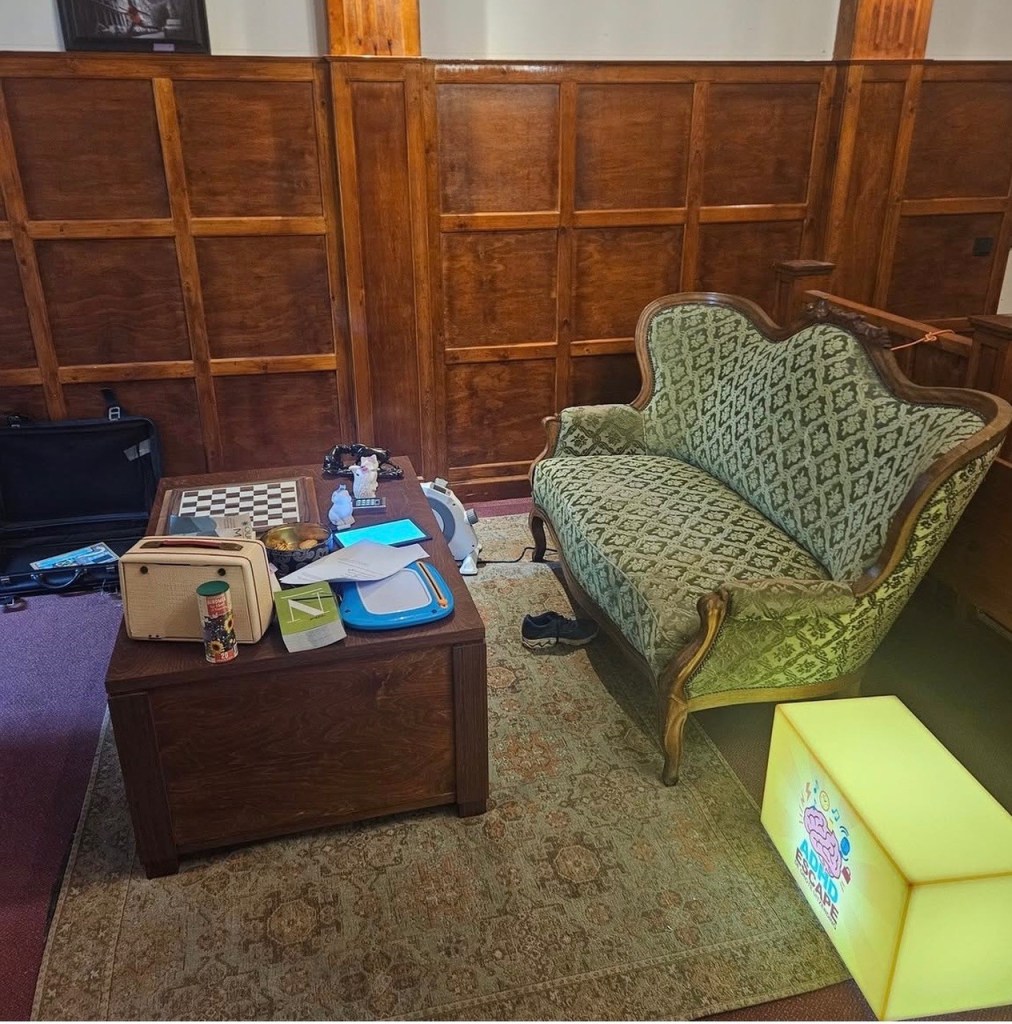
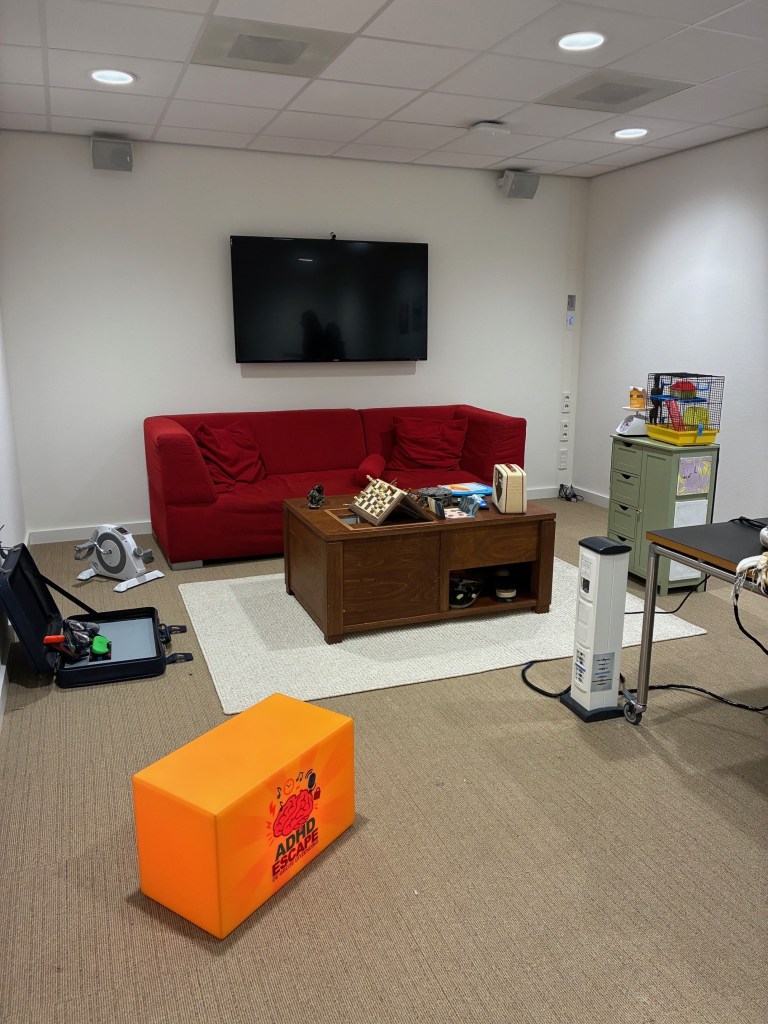
Also our ADHD escape room was open and ready to be played!

ADHD and creativity, Labmembers, Positive aspects of ADHD

ADHDawarenessMonth Post 3: our group’s contributions to the ECNP conference in Amsterdam

Oct 2025: This years European College of NeuroPsychopharmacology (ECNP) conference was held in Amsterdam. Our group was involved with 3 posters, 1 workshop and one symposium

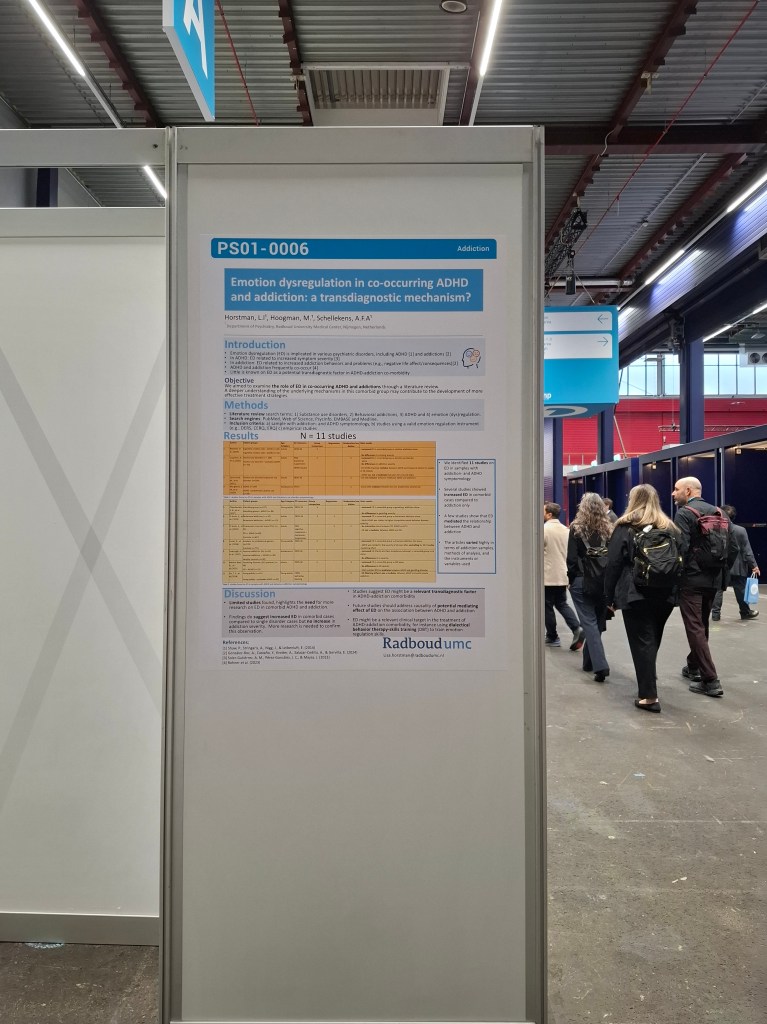
Poster: Emotion dysregulation as a core transdiagnostic symptom in co-occurring substance use disorder and ADHD: a review: Lisa Horstman

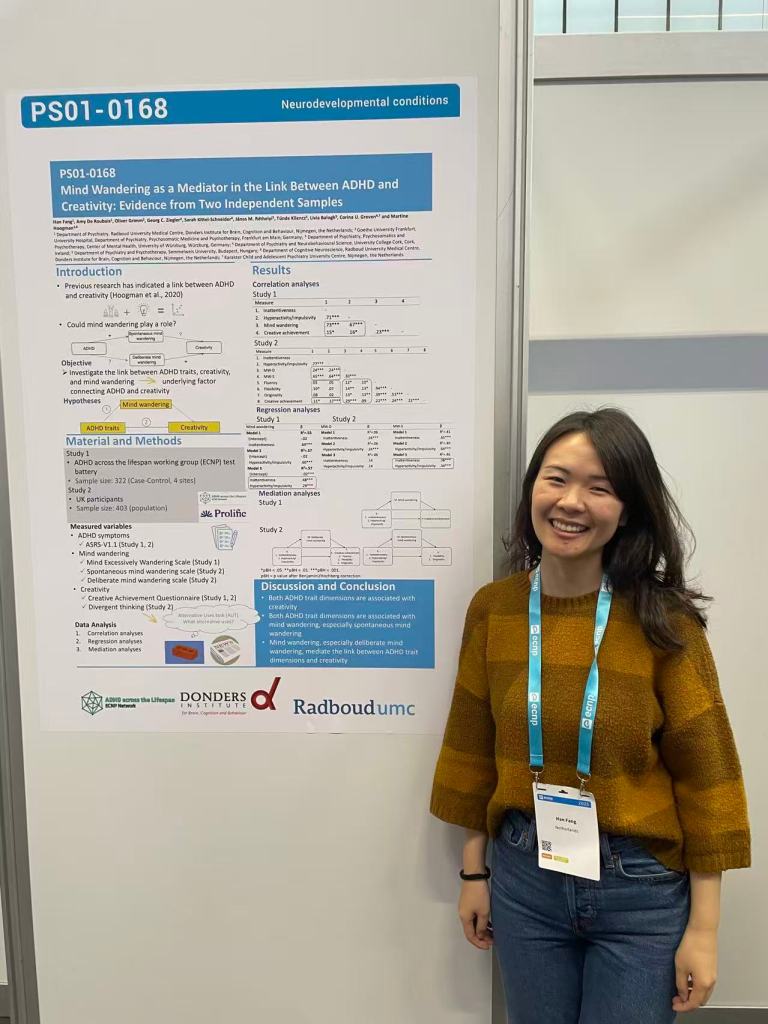
Poster: Mind wandering as a mediator in the link between ADHD and creativity: evidence from two independent samples, Han Fang. ECNP also published a press release about Han’s work, which was picked up by a number of scientific and medical websites.

Poster: Neurodivergent strengths and wellbeing: new insights from attention-deficit/hyperactivity disorder, Luca Hargitai

Workshop: How to excel your career in open science, Jeanette Mostert

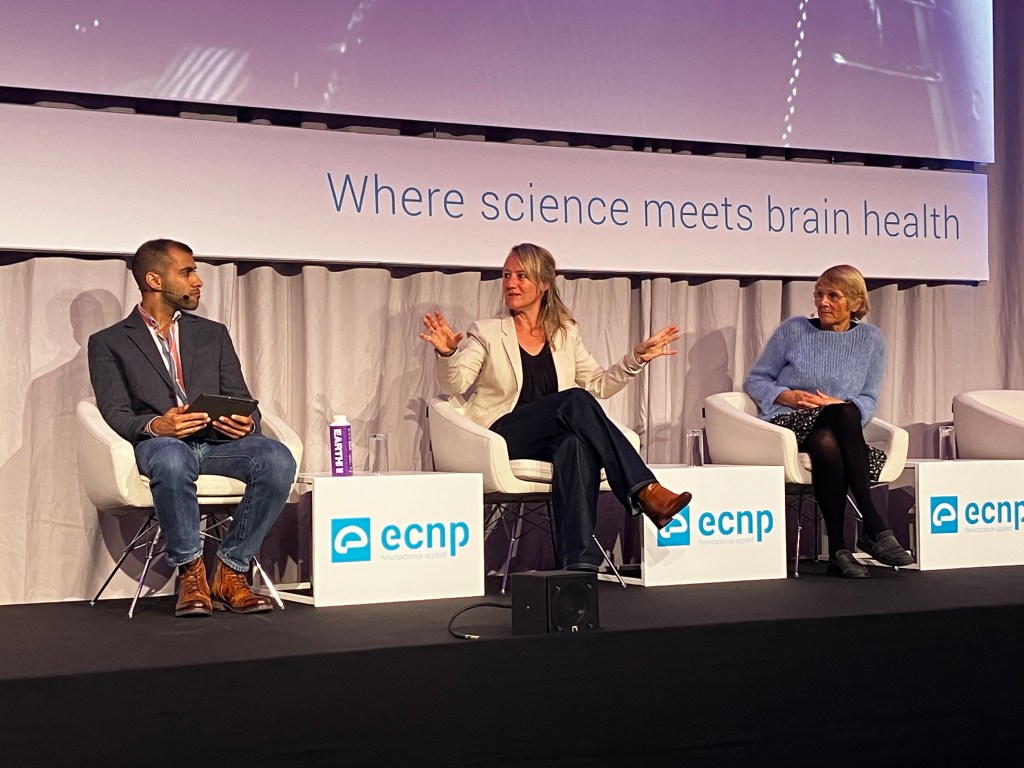
Symposium: Positive aspects and strengths in the context of neurodevelopmental conditions, Martine Hoogman

We all got great feedback and had a good time!

ADHD and creativity, ADHDplaza, Labmembers

ADHD world congres 2023 in Amsterdam

May 2023: The world federation of ADHD hosted the ADHD world congres 2023 in Amsterdam this year. The theme of the congres was ‘Modernizing the concept of ADHD’. There were contributions from our group: Lessa Schippers presented at the ERC meeting prior to the congres, Martine presented her work on strengths in ADHD on Friday in the first plenary session of the day and Lessa again presented in the young scientist session (where she won the Young Scientist Award!) on Saturday. It was also great catching up with former PhD-student Zhaomin Wu, who continued investigating ADHD back home in China and displayed her work in Amsterdam. New PhD-student Han was also attending the conference (with the help of the KNAW early career award of Martine) and got overwhelmed with all the ADHD research that is out there. Good inspirations for her and her work on creativity and well-being in the context of ADHD. Hopefully her work will be part of the next meeting, in 2 years in Prague.

The meeting attracted >1400 attendees, among which many colleagues from Nijmegen, collaborators from our (inter)national collaborations such as MocA, IMpACT and ENIGMA-ADHD, and also our your researchers from ADHDplaza. You can imagine how much fun we had, seeing all these familiar faces in one place.

ADHD and creativity, Positive aspects of ADHD

Campaign ‘aandacht voor neurologie’ (Telegraaf, Mediaplanet) with contribution Martine Hoogman

Dec 2022: Mediaplanet launched the ‘Attention to neurology‘ campaign on Friday, December 23, 2022. Articles about ADHD, Parkinson’s and MS can be read both online and in an appendix to Dutch newspaper ‘De Telegraaf’. Please read Martine Hoogman’s contribution about the positive aspects of ADHD, or Jan Buitelaar’s contribution about the brain and ADHD or Louise Smallenburg’s contribution about diagnosing ADHD. Articles are in Dutch.

Dec 2022: Mediaplanet lanceerde op vrijdag 23 december 2022 de campagne ‘Aandacht voor neurologie’. Zowel online als in een bijlage bij De Telegraaf zijn artikelen te lezen over onder andere ADHD, Parkinson en MS. Lees hier de bijdrage van Martine Hoogman over positieve kanten van ADHD, of de bijdrage van Jan Buitelaar over de hersenen en ADHD of de bijdrage van Louise Smallenburg over het stellen van de diagnose ADHD.


ADHD and creativity, Positive aspects of ADHD

Article in ‘EOS Wetenschap’ on positive aspects of psychiatric conditions

Dec 2022: Martine Hoogman was asked to write an article about positive aspects of psychiatric conditions for the special edition ‘Personal Growth’ of EOS Science magazine. In this article she writes about scientific evidence for specific strengths related to for example ADHD and autism but she also puts these strengths and positive aspect in perspective as these aspects most often do not wipe out the negative aspects. The article is in Dutch.

Dec 2022: Martine Hoogman werd gevraagd om een stuk te schrijven over positieve aspecten van psychiatrische aandoeningen voor de speciale editie ‘Persoonlijke groei’ van EOS wetenschap. In dit artikel beschrijft ze wetenschappelijke studies die gaan over het identificeren van positieve aspecten van bijvoorbeeld ADHD en autisme maar ze heeft ook een relativerende boodschap: de positieve aspecten zullen meestal de negatieve aspecten niet wegnemen. Het artikel is in het Nederlands.

ADHD and creativity, Positive aspects of ADHD

Article in the Impuls & Woortblind magazine

Nov 2022: Lessa Schippers and Martine Hoogman were asked to write an article for the Impuls & Woortblind magazine about their research on self-reported positive aspects in ADHD. This project was performed in collaboration with Impuls & Woortblind, the Dutch organisation for people with ADHD, dyslexia and dyscalculia.

to read the article please visit https://impulsenwoortblind.nl/magazine/

ADHD and creativity, Positive aspects of ADHD

ADHD awareness month 2022 (1)

Oct 2022: Our group is involved in two pubic events during the ADHD awareness month 2022.

On the1st of October group members Lessa, Lisa and Rowen organized a live experiment at the Donders Institute Open Day. In general, the open day attracted 1000 visitors of all ages. Also at our live experiment it were busy times. Visitors filled out the ADHD symptom rating scale and performed the Alternative Uses Task. Here you should come up with alternative uses for a known object. The results for both the questionnaire and the task were put on a post-it, which was pasted on the wall. In the picture you can see a nice distribution of the scores….do we see a positive correlation….? Well done every one! Thanks for visiting us.

Lab members Lessa Schippers and Lisa Horstman on the Donders Open Day: results of the live experiment

Children could work on the Alien Fruit Task, drawing a picture of fruits from outer space. This nicely matched the talk from our national space traveler, Andre Kuipers.

Our second contribution to ADHD awareness month will be on the Leiden City of Science event on the 15th of October. More about this event later.

Verslag van Lessa: Op zaterdag 1 oktober was de open dag van het Donders Instituut, in het kader van Weekend van de wetenschap maar ook voor ADHD awareness month. We waren goed vertegenwoordigd met Lisa, Lessa en Rowen.

Tijdens de open dag hebben we een live experiment gedaan om de correlatie te laten zien tussen ADHD kenmerken en creativiteit. Bezoekers deden de alternative use task, waarbij het de bedoeling was om zo veel mogelijk alternatieve gebruiken te vinden voor een alledaags voorwerp, in dit geval een krant, een schoen of een baksteen. Daarna vulden ze een vragenlijst over ADHD kenmerken in. Op de muur was een grafiek gemaakt met op de x-as ADHD kenmerken en op de y-as creativiteit. Met een post-it konden bezoekers aan de hand van hun scores hun naam in de grafiek plaatsen. Aan het eind van de dag hadden we een mooie positieve correlatie tussen ADHD en creativiteit.

Speciaal voor kinderen hadden we de alien fruit taak. Hierbij tekenen de kinderen hoe zij denken dat fruit er op een buitenaardse planeet uitziet. Dit was heel toepasselijk, aangezien André Kuipers ook aanwezig was voor een presentatie! Dit was een mooi evenement om ons onderzoek op de kaart te zetten en mensen meer te leren over ADHD en creativiteit!