
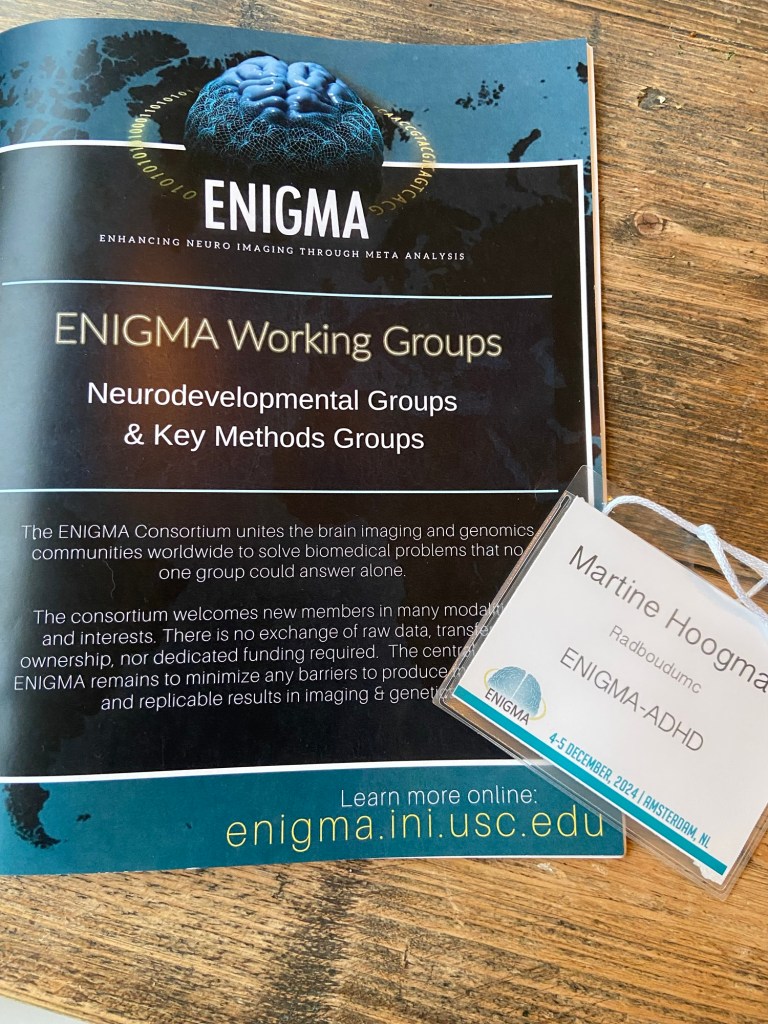
Dec 2025: It was a great ENIGMA summit in Amsterdam, where neurodevelopmental working groups and methods working groups met to share the latest results and tried to find new ways to collaborate. I will share here some of Paul Thompson’s (PI ENIGMA) conclusions of the 2-day meeting:

Today’s ENIGMA Summit compared over 20 brain disorders in tens of thousands of people scanned with MRI, and suggests that:
1. brain disorders that hit very early, before birth (e.g. those due to genomic copy number variants such as genetic deletions) tend to affect cortical surface area, often excessively in primary sensorimotor cortex
2. neurodevelopmental brain disorders that hit after birth but before adolescence tend to reduce cortical surface area more than (i.e. with greater effect sizes than) they reduce cortical thickness but more in a transmodal association cortex pattern than a primary sensorimotor pattern; these can be split into an strong externalizing and a weak internalizing pattern depending on the disorder type [4]
3. brain disorders that hit after puberty tend to affect cortical thickness, more so than regional cortical surface area, with some exceptions, as do adult onset disorders
4. the last category of mainly-thickness-deficit disorders can have their abnormality decomposed into 3 components – (1) a general component common to all disorders (PC1 in Zhipeng Cao’s work [2]), (2) a disorder specific component, and (3) a medication effect
5. focusing on the first two of these, there is a transdiagnostic covariance [1] that spans the set of disorder effects on the cortex and consists of 2 primary axes of disturbance, G1 and G2
6. to some extent, the amount and anatomical distribution of structural brain deviation in a disorder depends on the location and profile of greatest normal age-related brain change that is normally occurring in healthy people when the disorder hits and can look like an exaggerated version of that change, i.e. ‘aging’
7. some of this is set out more formally in the transdiagnostic ENIGMA papers by Meike Hettwer/Sofie Valk on transdiagnostic covariance [1] and brain gradients, and in the linear PCA paper by Zhipeng Cao Hugh Garavan and ENIGMA [2]. For the CNV part see work by Clara Moreau [3], and for the childhood part see work by Sophie Townend and 4 of the ENIGMA neurodevelopmental working groups [unpublished except an abstract].
This is not really obvious until you see all the work presented together (as it was today at the ENIGMA Summit).
References:
- Hettwer et al., Nature Communications, 2022
- Cao et al., Mol Psychiatry, 2022
- Moreau et a., Curr Opin Genet Dev 2022
- Townend et al, https://osf.io/g42u5/

 Research group 'Strengths, positive aspects and resilience factors in neurodevelopmental conditions'