Okt 2026: Neurodiversiteit… Het is een hot topic waar steeds meer aandacht voor is. Het concept van neurodiversiteit verwijst naar de variatie in het menselijk denken en functioneren. In tegenstelling tot de klassiekere conceptualisaties door psychiaters in de jaren 60 worden aandoeningen zoals ADHD en autisme niet meer gezien als een “stoornis” die eigen is aan de persoon zelf. Binnen het neurodiversiteitsdenken wordt ADHD bijvoorbeeld gezien als een andere manier van denken en functioneren: niet beter of slechter, gewoon anders. Het woord “neurotypisch” verwijst doorgaans naar mensen die bij de middenmoot of meerderheid behoren terwijl de term “neurodivergent” verwijst naar onder andere mensen met bijvoorbeeld ADHD, autisme, of dyslexie.
Er wordt al veel gesproken en geschreven over neurodiversiteit, ook worden de eerste studies al gedaan naar dit onderwerp. Wat nog onbekend is: wat vinden mensen met ADHD zelf van dit concept? Samen met Impuls & Woortblind (de Nederlandse organisatie voor mensen met ADHD, dyslexie en dyscalculie) zetten we een vragenlijst op om dit te bevragen. Hierin werkten we samen met het Platform Wetenschap ADHD, een unieke samenwerking (co-creatie) die wetenschappers, behandelaren en ervaringsdeskundigen rondom ADHD bij elkaar brengt. Uiteindelijk konden we antwoorden verzamelen van 224 volwassenen met ADHD.
De meeste mensen (86%) hadden wel al eens gehoord van neurodiversiteit en 76% vond het neurodiversiteitsdenken een aantrekkelijke manier van denken. Mensen met ADHD definieerden neurodiversiteit op veel verschillende manieren, wat duidelijk maakt dat het concept geen eenduidige definitie heeft. Belangrijker is misschien nog dat volwassenen met ADHD in Nederland die de vragenlijst invulden zowel voor- als nadelen zagen aan het neurodiversiteitsdenken. Zo waren ze erg te spreken over het feit dat het concept van neurodiversiteit kan bijdragen aan meer acceptatie, erkenning en normalisatie van diversiteit. Ook het feit dat neurodiversiteit over iedereen gaat (iedereen heeft namelijk een unieke manier van zijn en denken), een neutralere term is dan medische diagnoses en minder dwingt om in hokjes te denken, vonden veel deelnemers positief.
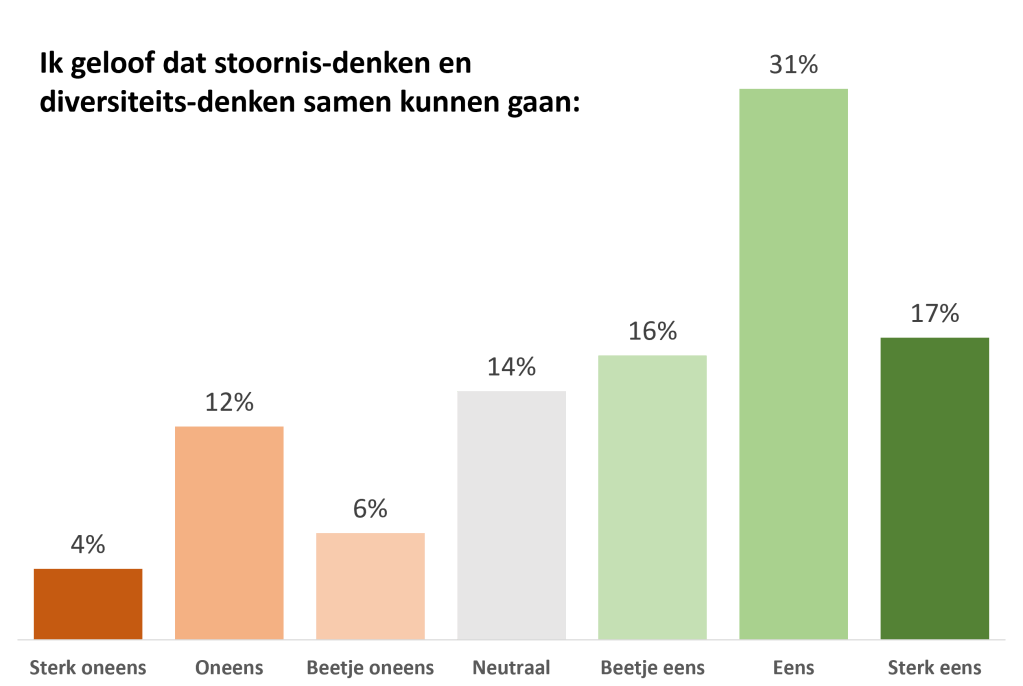
Tegelijkertijd gaven ze ook aan dat het concept neurodiversiteit wat vaag en breed kan zijn, want over wie hebben we het dan nog als het over iedereen gaat? En krijg je dan nog wel toegang tot zorg als het “gewoon maar” een andere manier van zijn en denken is? Toch is 64% van de deelnemers het eens dat het klassieke deficit-denken hand wel in hand kan gaan met het nieuwere neurodiversiteitsdenken (zie onderstaande figuur).
Onze resultaten tonen aan dat er nog veel discussie is over neurodiversiteit, met voor- en nadelen en met voor- en tegenstanders, ook binnen neurodivergente groepen zoals mensen met ADHD. We zullen ongetwijfeld nog veel veranderingen zien in hoe neurodiversiteit wordt gedefinieerd en hoe mensen zich daartoe verhouden. Het is alleszins belangrijk dat, wanneer we spreken over iets als neurodiversiteit en zeker neurodivergentie, we dat doen samen met de mensen over wie het gaat. Dit onderzoek is daarmee ook een belangrijk eerste samenwerkingsproduct uit het Platform Wetenschap ADHD.
Ben je benieuwd naar de volledige paper? Die kan je hier terugvinden:
De Roubaix, A., Schippers, L. M., Abels, R., Van Casteren, P., Franke, B., Greven, C. U., Hoekstra, P. J., Hurks, P. P. M., Meilink, A., Pereira, R. R., Scheres, A., Sobolewska, A. M., Van De Velde, H., Dekkers, T. J., & Hoogman, M. (2026). Perceptions of the Neurodiversity Concept: Threat or Opportunity for Adults With ADHD? Neurodiversity, 4. https://doi.org/10.1177/27546330261490602
Oct 2026: Neurodiversity is a hot topic that is receiving increasing attention. The concept of neurodiversity refers to the natural variation in human thinking and functioning. In contrast to more traditional conceptualizations developed by psychiatrists in the 1960s, conditions such as ADHD and autism are no longer viewed solely as disorders that reside within the individual. Within the neurodiversity paradigm, ADHD, for example, is seen as a different way of thinking and functioning: not better or worse, simply different. The term neurotypical generally refers to people whose cognitive and behavioral characteristics fall within the majority or average range, whereas neurodivergent refers to people with conditions such as ADHD, autism, or dyslexia.
Much has already been said and written about neurodiversity, and the first scientific studies on the topic have begun to emerge. What remains largely unknown, however, is how people with ADHD themselves view this concept. Together with Impuls & Woortblind (the Dutch organization for people with ADHD, dyslexia, and dyscalculia), we developed a survey to explore this question. The project was conducted in collaboration with the Platform Wetenschap ADHD, a unique co-creation initiative that brings together researchers, clinicians, and individuals with lived experience of ADHD. Ultimately, we collected responses from 224 adults with ADHD.
Most participants (86%) had heard of neurodiversity before, and 76% considered the neurodiversity perspective an appealing way of thinking. People with ADHD defined neurodiversity in many different ways, underscoring the absence of a single, universally accepted definition of the concept. Perhaps more importantly, Dutch adults with ADHD who completed the survey identified both advantages and disadvantages of the neurodiversity perspective.
Participants were particularly positive about the idea that neurodiversity may promote greater acceptance, recognition, and normalization of human differences. Many also appreciated that neurodiversity applies to everyone, since everyone has their own unique way of being and thinking. In addition, they viewed the concept as a more neutral term than medical diagnoses and as a framework that places less emphasis on categorizing people into rigid boxes.
At the same time, participants noted that the concept of neurodiversity can be somewhat vague and broad. If neurodiversity applies to everyone, they asked, who exactly are we referring to? They also questioned whether people would still have adequate access to care and support if ADHD were regarded as “just” a different way of being and thinking. Nevertheless, 64% of participants agreed that the traditional deficit-based perspective and the newer neurodiversity perspective can coexist and complement one another (see figure below).
Our results show that there is still much discussion surrounding neurodiversity, with both advantages and disadvantages, and with supporters as well as critics, including within neurodivergent groups such as people with ADHD. We will undoubtedly continue to see many changes in how neurodiversity is defined and how people relate to it. It is important, in any case, that when we talk about something like neurodiversity, and especially neurodivergence, we do so together with the people whom it concerns. This study therefore also represents an important first collaborative product of the Dutch ADHD Science Platform.
Are you curious about the full paper? You can find it here:
De Roubaix, A., Schippers, L. M., Abels, R., Van Casteren, P., Franke, B., Greven, C. U., Hoekstra, P. J., Hurks, P. P. M., Meilink, A., Pereira, R. R., Scheres, A., Sobolewska, A. M., Van De Velde, H., Dekkers, T. J., & Hoogman, M. (2026). Perceptions of the Neurodiversity Concept: Threat or Opportunity for Adults With ADHD? Neurodiversity, 4. https://doi.org/10.1177/27546330261490602


