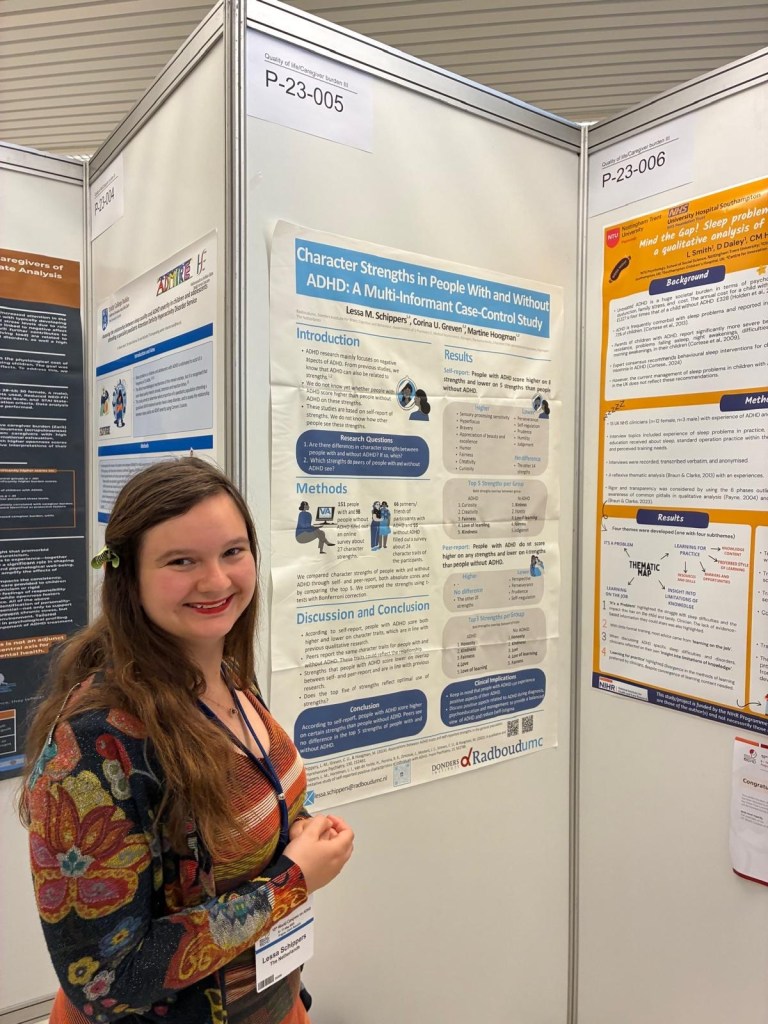
April 2025: Lessa and Martine attended the Dutch Psychiatry Spring Conference in Maastricht to present their work. Lessa had a poster (in Dutch: ‘Positieve karaktereigenschappen van ADHD: Een zelf- en peer-report case-control studie’) but also had the opportunity to do a pecha kucha. Martine was part of the session for invited professors (Innovatieve Benaderingen in de Psychiatrie: Van Onderzoek naar Toepassing) and presented an overview of her labs work on positive aspects of ADHD. It was a great experience to share our work en get feedback from Dutch clinicians.
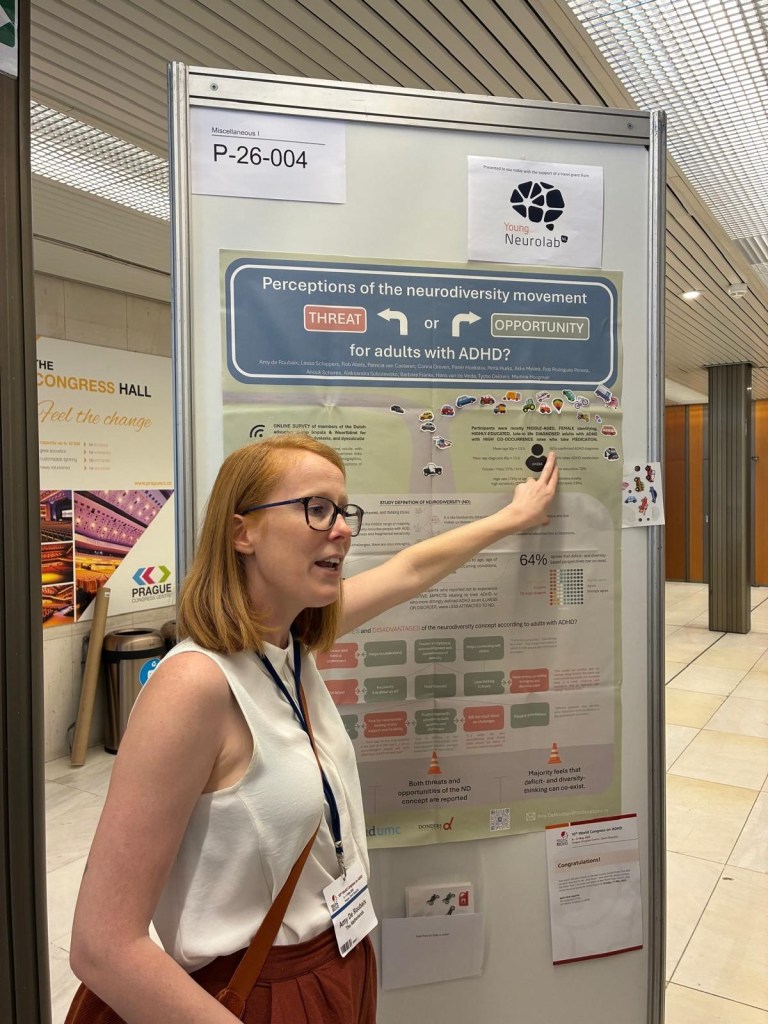
May 2025: Our lab members Han Fang (PhD candidate) and Amy de Roubaix (postdoc) were nominated for the best poster award at the ADHD world congress in Prague this year. Han Fang presented her poster about ongoing work on Creativity, mindwandering and ADHD. Amy presented her poster entitled: Perceptions of the neurodiversity movement: Threat or opportunity for adults with ADHD? She was very active in her presentation, trying to get people to put stickers on her poster to capture the audience’s perspectives on the neurodiversity movement. This (probably ;-)) led to her winning one of the six Best Poster awards at the conference. Well done both!
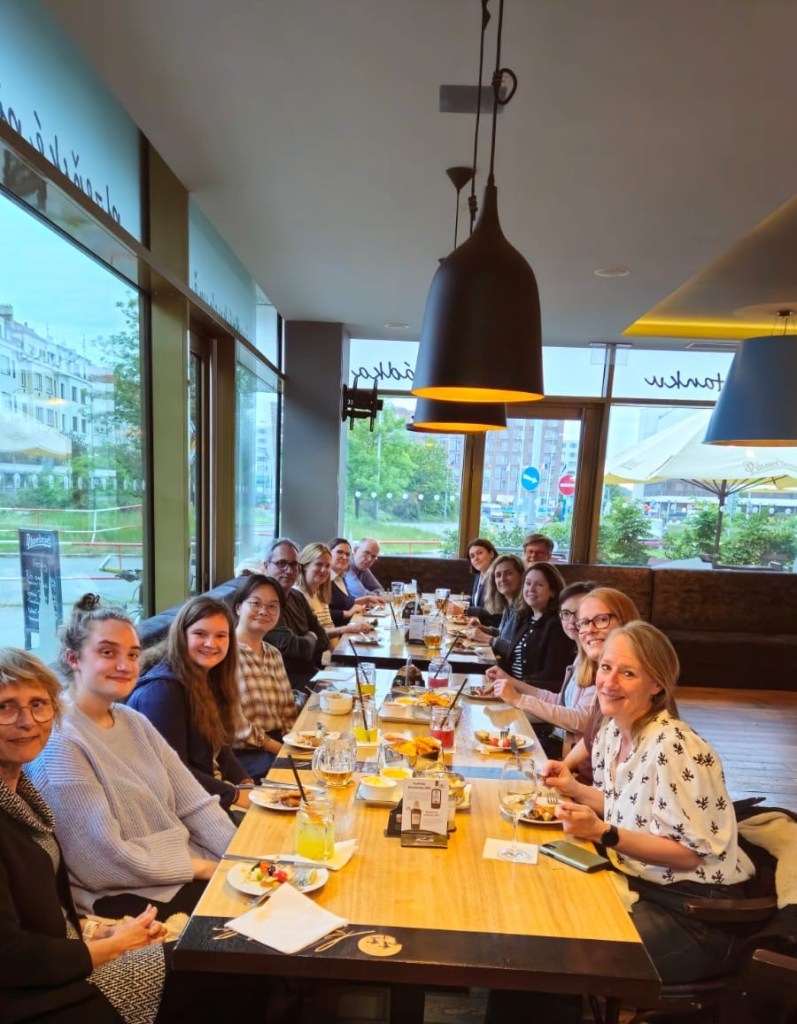
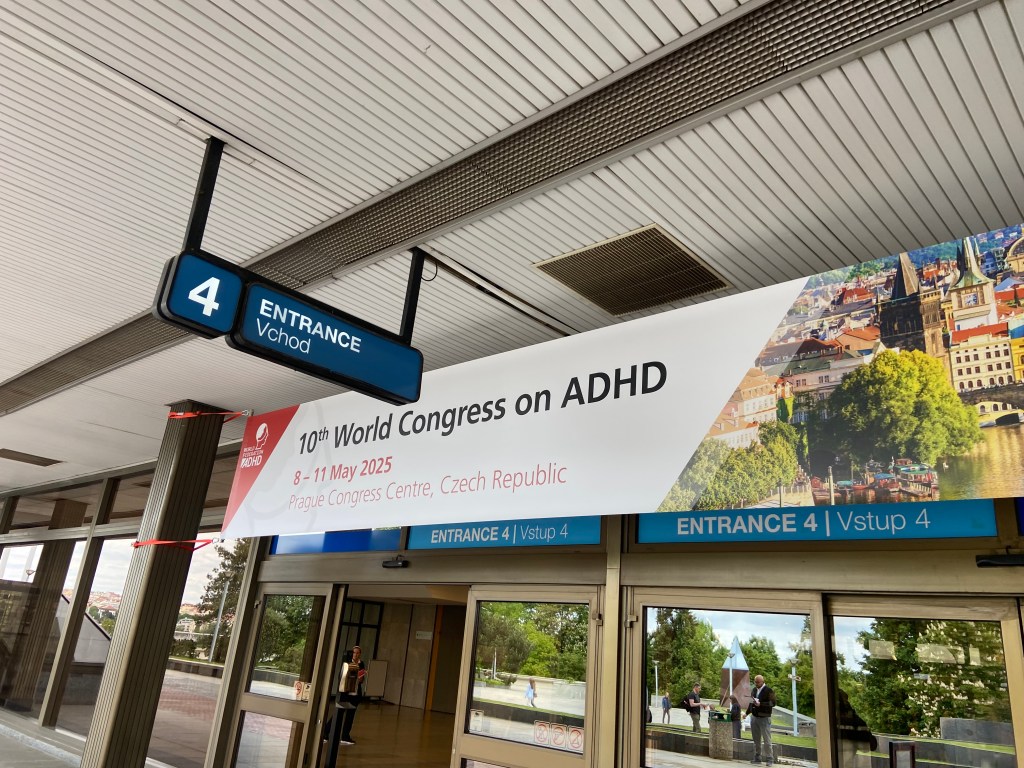
May 2025: We were lucky enough to go to the ADHD world congress in Prague with many members of our lab. Amy de Roubaix, Han Fang, Lessa Schippers, Lisa Horstman and Biqing Chi were all there to present their posters about their ongoing work. Fortunately, we also met up with our former member, Luca Hargitai (University of Bath), who also presented a poster at the conference. Martine Hoogman presented an overview of our groups work in the session, co-chaired with Edmund Sonuga-Barke, entitled: Neurodiversity approach: Evidence for positive and strength focused aspects in ADHD. We were amazed to see so many people there, even sitting on the floor. In this session, Nitzan Shahar, Brandy Callahan and Myriam Bea shared the latest about attitudes towards ADHD, factors supporting succesful functioning and how (some) people with ADHD do not want to give up their ADHD.
April 2025: Even delen dat onze geocache ‘Geocache je mee en leer wat over ADHD‘ al meer dan 100 keer is gevonden. Dat vinden we heel leuk!
Daarnaast lieten veel mensen een leuke review achter, waaronder deze:
In deze stralende ochtend zon op weg naar mijn werk een extra lange wandeling gemaakt via deze adventure lab. Als docent aan de medische faculteit was ik heel nieuwsgierig. Leuk educatie materiaal. Goed gedaan 👍
ik had moeite om vandaag van de bank af te komen, deze lab gaf het zetje dat ik nodig had. Oudste dochter is ca 5 jaar geleden gediagnosticeerd met ADD, dus de info kwam me allemaal wel bekend voor. Maar mooi dat er aandacht voor is zo! Ook bijzonder om tijdens de wandeling alle werkzaamheden aan het ziekenhuis te zien.
Bedankt Geocachers!
April 2025: Just to share that our geocache about ADHD has already been found more than 100 times. We are really excited about that!
Many people left a nice review, including these ones:
“In this bright morning sun on my way to work I took an extra long walk via this adventure lab. As a teacher at the medical faculty I was very curious. Nice educational material. Well done 👍”
“I had trouble getting off the couch today, this lab gave me the push I needed. My oldest daughter was diagnosed with ADD about 5 years ago, so the information all seemed familiar to me. But it’s great that there is attention for it like this! Also special to see all the construction work on the hospital during the walk.”
April 2025: Op dinsdag 8 april organiseren onderzoekers van ons lab samen met het ADHD-Café Nijmegen een speciale editie. Deze avond staat volledig in het teken van kennisdeling en ervaringsuitwisseling. PhD student Lessa Schippers en postdoc Amy de Roubaix presenteren hun onderzoeksresultaten en studenten van het honourslab ADHD Escape room gaan in gesprek met de bezoekers van het café.
Het ADHD-Café is een initiatief van Impuls & Woortblind. Dé belangenvereniging voor volwassenen met ADHD, dyslexie en dyscalculie. Sinds augustus 2024 organiseert vrijwilligster (en tevens ervaringsdeskundig coach) Mandy Gout, iedere tweede dinsdag van de maand een bijeenkomst bij restaurant De Vier Heeren op de Sint Annastraat in Nijmegen. Het doel is om ervaringen uit te wisselen, herkenning en erkenning bij elkaar te vinden. Dit is voor veel deelnemers heel erg helpend bij het leren omgaan met ADHD en het omarmen van de positieve aspecten van een bruisend brein.
Intussen zijn wij ook bezig met allerlei initiatieven om het leven met ADHD beter te begrijpen. Dit voorjaar werken er namelijk 15 studenten van de Radboud Universiteit en de HAN samen aan een project waarin ze een Escape Room ontwerpen die ADHD op een ervaringsgerichte manier inzichtelijk maakt. Ongeveer een derde van hen heeft zelf ADHD; de anderen willen door middel van dit project beter begrijpen hoe het is om met ADHD te leven. Tijdens het ADHD-Café delen zij hun eerste ideeën en vragen ze het publiek om feedback. De Escape Room zal dan vanaf omstreeks juni te bezoeken zijn in het Donders Brein Museum.
Wat kun je van het ADHD-Café van 8 april verwachten?
· Korte lezingen met onderzoeksresultaten over ADHD:
-Positieve aspecten van ADHD
-Percepties van neurodiversiteit bij volwassenen met ADHD
· Studenten pitchen hun eerste ideeën voor de ADHD Escape Room en horen graag jouw feedback!
· Informele borrel om verder te praten en ervaringen te delen.
Praktische informatie:
Datum: Dinsdag 8 april Tijd: 19:15 inloop, 19:30 start, 21:00u borrel, 21:30 afsluiting Entree: €3 voor leden / €4 voor niet-leden van Impuls & Woortblind; drankjes voor eigen rekening.
Deze avond biedt een unieke kans om wetenschappelijke inzichten, ervaringsverhalen en creativiteit samen te brengen. Wil jij bijdragen aan een vernieuwende manier om ADHD zichtbaar te maken? Meld je dan aan en praat, denk en borrel mee!
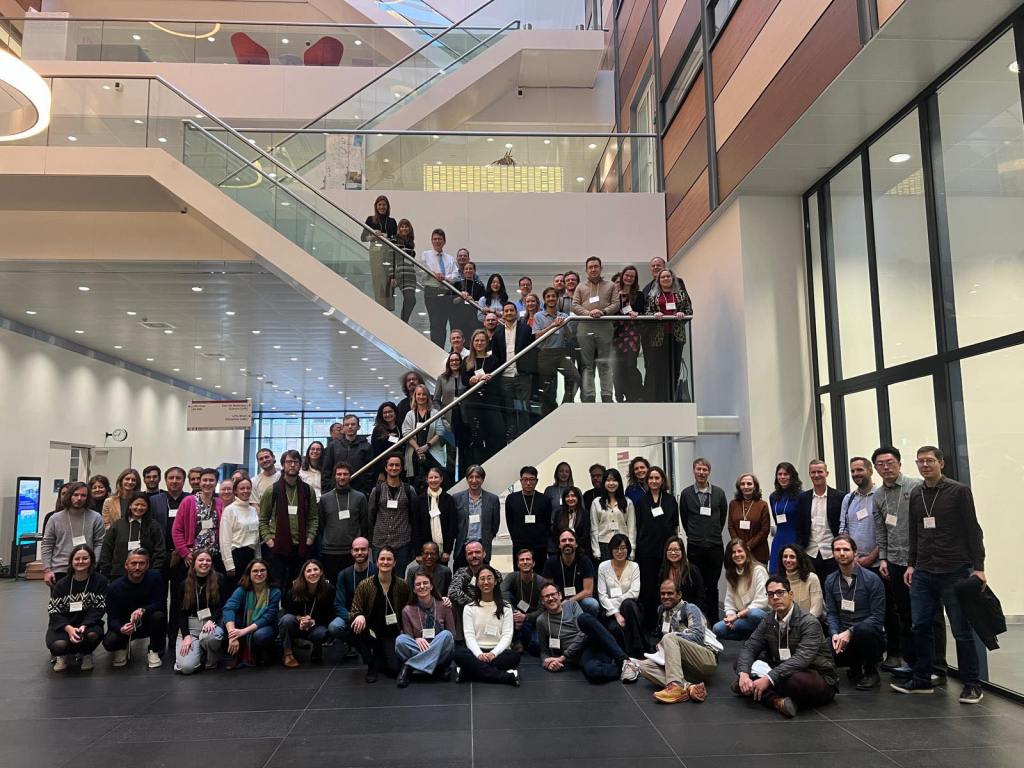
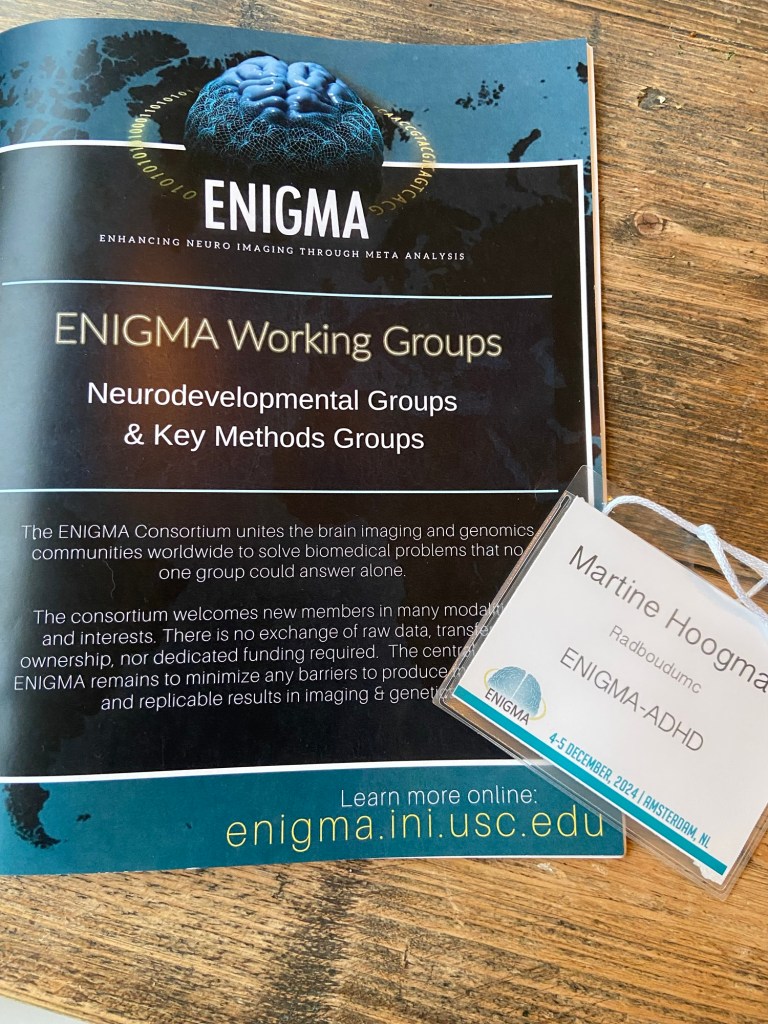
Dec 2025: It was a great ENIGMA summit in Amsterdam, where neurodevelopmental working groups and methods working groups met to share the latest results and tried to find new ways to collaborate. I will share here some of Paul Thompson’s (PI ENIGMA) conclusions of the 2-day meeting:
Today’s ENIGMA Summit compared over 20 brain disorders in tens of thousands of people scanned with MRI, and suggests that:
1. brain disorders that hit very early, before birth (e.g. those due to genomic copy number variants such as genetic deletions) tend to affect cortical surface area, often excessively in primary sensorimotor cortex
2. neurodevelopmental brain disorders that hit after birth but before adolescence tend to reduce cortical surface area more than (i.e. with greater effect sizes than) they reduce cortical thickness but more in a transmodal association cortex pattern than a primary sensorimotor pattern; these can be split into an strong externalizing and a weak internalizing pattern depending on the disorder type [4]
3. brain disorders that hit after puberty tend to affect cortical thickness, more so than regional cortical surface area, with some exceptions, as do adult onset disorders
4. the last category of mainly-thickness-deficit disorders can have their abnormality decomposed into 3 components – (1) a general component common to all disorders (PC1 in Zhipeng Cao’s work [2]), (2) a disorder specific component, and (3) a medication effect
5. focusing on the first two of these, there is a transdiagnostic covariance [1] that spans the set of disorder effects on the cortex and consists of 2 primary axes of disturbance, G1 and G2
6. to some extent, the amount and anatomical distribution of structural brain deviation in a disorder depends on the location and profile of greatest normal age-related brain change that is normally occurring in healthy people when the disorder hits and can look like an exaggerated version of that change, i.e. ‘aging’
7. some of this is set out more formally in the transdiagnostic ENIGMA papers by Meike Hettwer/Sofie Valk on transdiagnostic covariance [1] and brain gradients, and in the linear PCA paper by Zhipeng Cao Hugh Garavan and ENIGMA [2]. For the CNV part see work by Clara Moreau [3], and for the childhood part see work by Sophie Townend and 4 of the ENIGMA neurodevelopmental working groups [unpublished except an abstract].
This is not really obvious until you see all the work presented together (as it was today at the ENIGMA Summit).
Nov 2024: It was only a short visit of 9 weeks, but it was a great experience having Luca Hargitai, PhD student from the University of Bath in our group. We are sad to say goodbey and will miss her so much but fortunately, we have set up a very exciting new project when she was in Nijmegen, so we will keep on working together.
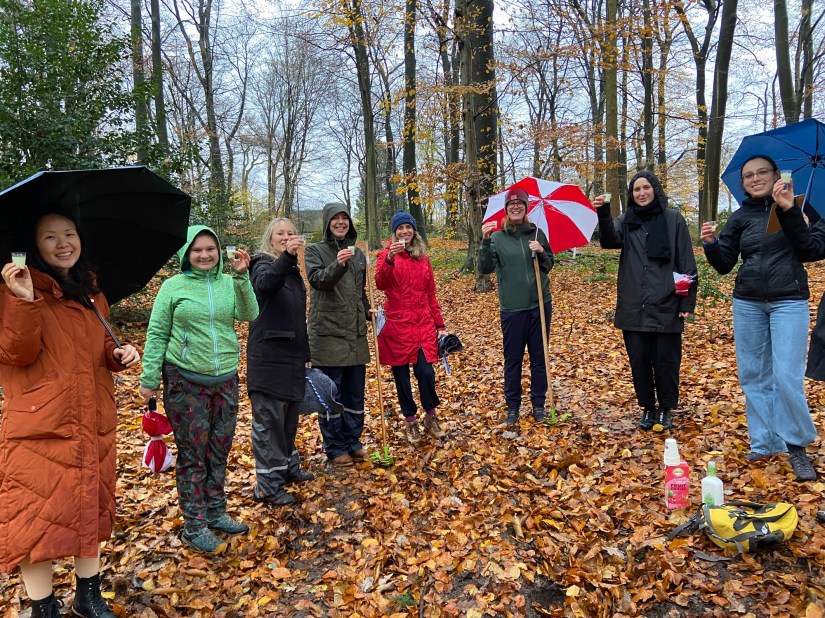
Nov 2024: The lab-groups of Corina Greven and Martine Hoogman joined forces to together work on a lab handbook for both labs. This was done during a 1,5 day lab retreat at the Holthurnsche Hof in Berg en Dal. It was a great success, and talking about our lab culture, development as a researcher, scientific vision and practicallities mainly for newcomers also brought us closer to one another. To get some fresh air, we put on our rain coats and went outside for a round of ‘klootschieten‘.
oct 2024: We have three excellent new group members, and they present themselves here:
Luca Hargitai
My name is Luca, and I am a visiting PhD student from the University of Bath in the UK. My research explores life outcomes in autism and ADHD and aims to improve our understanding of these neurodevelopmental conditions across the lifespan. I am particularly interested in how neurodevelopmental traits relate to mental health and I am passionate about utilising robust research to inform clinical practice in mental healthcare.
During my research placement, I will be investigating psychological strengths in ADHD. Through this project, we hope to better understand how being aware of these strengths and using them in everyday life relates to people’s wellbeing.
Amy de Roubaix
My name is Amy De Roubaix and I am a Belgian researcher with a background in pediatric physiotherapy. For the past seven years, I have investigated the early signs of the neurodevelopmental condition ‘Developmental Coordination Disorder’ (DCD) and its impact on children and their families. Since DCD very often co-occurs with ADHD, I am excited to broaden my research focus within the psychiatric research group at UMC Nijmegen.
I believe it is important to focus not only on perceived challenges but also on the positive aspects and opportunities of neurodivergence. I am excited to explore these strengths more deeply as a postdoctoral researcher. I will be working on the NWO Vidi project, ‘ADHD SPARCS,’ which examines the positive aspects of ADHD as reported by those around individuals with ADHD, how context influences ADHD-related strengths, and the neurobiological factors underlying these strengths.
Inge van Walraven
I am Inge Walraven, and I have been working at Radboudumc for 9 years. In recent years, I have been responsible for recruiting participants and communicating with participants for the Healthy Brain Study, a research project focused on the brains of people in their thirties. This project has now been completed.
On October 1st, I started as an Information & Communication Officer in Martine Hoogman’s group. In my new role, I will focus on establishing and maintaining a network for Radboudumc employees who are neurodiverse. The goal of this network is to share scientific knowledge about, for exmple, ADHD with employees and to gather input from employees with ADHD regarding research ideas and outcomes. I am very excited to get started with this wonderful project.
Oct 2024: We are looking for a PhD candidate to join our group. The candidate will be working on the NWO vidi project of Martine Hoogman on positive aspects of ADHD. Please read more here












 Research group 'Strengths, positive aspects and resilience factors in neurodevelopmental conditions'